youtube-transcript.ai

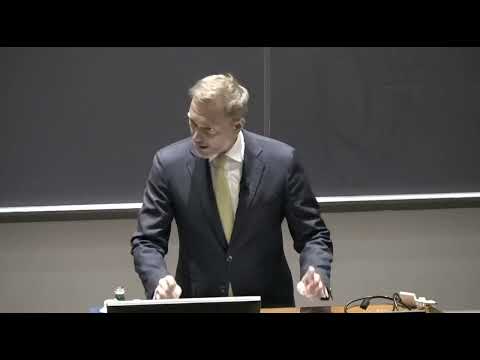
German Minister of Finance at Princeton University

Watch with subtitles, summary & AI chat
Add the free Subkun extension — works directly on YouTube.
  • Watch
  • Subtitles
  • Summary
  • Ask AI
Try free →

This video is for individuals interested in political philosophy, economics, and the future of liberal democratic societies.

TL;DR

Germany's Finance Minister Christian Lindner discusses the challenges facing liberalism today, including threats from cancel culture, social media, and industrial policies. He argues for liberalism's core principle of individualism and its capacity for progress, while addressing criticisms from both the left and the right.

Key Takeaways

In This Video

  1. 00:00Welcome and Introduction

    The German Finance Minister is welcomed to Princeton. He is introduced as the leader of the FDP and an advocate for free society.

  2. 00:41Challenges to Liberal Society

    Liberal society faces threats from cancel culture, social media distortion, and industrial policies. New technologies like AI pose risks.

  3. 02:00Global Economy and Resilience

    The minister discusses the global economy and world order, emphasizing the need for resilience against shocks.

  4. 03:29Honored to be at Princeton

    The minister expresses honor to be at Princeton, a place of refuge for scholars fleeing the Nazi regime.

  5. 05:13Advocating for Liberty

    The minister prioritizes discussing the idea of freedom over international financial policies, seeing it as urgent.

  6. 06:14Liberalism Under Question

    The liberal order is being questioned and challenged. Liberalism is perceived as failing politically and intellectually.

  7. 08:10Individualism at the Core

    Liberalism places the individual center stage, contrasting with collectivistic philosophies. Freedom is a necessary condition for a dignified life.

Questions & Answers

What is the main topic of the German Finance Minister's talk at Princeton?
The German Finance Minister's talk at Princeton focuses on liberalism, its challenges, and its future as an idea for structuring human coexistence, rather than just international financial policies.
How does the speaker define liberalism in the German context?
In the German context, liberalism is closer to classical liberalism, emphasizing the individual as the center of society and guaranteeing rights like freedom of speech and property.
What are the main criticisms of liberalism from the left and the right?
The left criticizes liberalism for exploitation, poverty, and inequality, while the right accuses it of destroying traditions, cohesion, and cultural identities.
What does the speaker identify as the core of liberalism?
The speaker identifies liberalism's core as its capacity to learn and its faith in progress as an incremental process of human civilization.
Why is the concept of homogeneity seen as authoritarian in a liberal society?
A liberal society is inherently diverse because it places the individual center stage with equal rights, making homogeneity an authoritarian concept that contradicts this principle.
What historical figures and movements are mentioned as foundational to liberalism?
The speaker mentions John Locke, the French Revolution, the German Enlightenment, and the American independence movement as foundational to liberalism.

Key Terms

Download or copy the punctuated YouTube transcript (Markdown)

Full Transcript

Loading transcript…
Source

YouTube video. Original: https://www.youtube.com/watch?v=khFbTAmYNls
Transcript captured and processed by youtube-transcript.ai on 2026-05-31.