youtube-transcript.ai

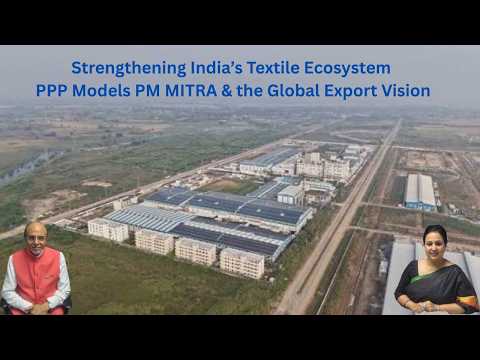
Textile Parks PPP: Podcast EP 46 #TextileParks #PMMITRA #PPP #TextileIndustry #MakeInIndia

Watch with subtitles, summary & AI chat
Add the free Subkun extension — works directly on YouTube.
  • Watch
  • Subtitles
  • Summary
  • Ask AI
Try free →

Policy analysts, textile entrepreneurs, and investors evaluating India's industrial infrastructure schemes.

TL;DR

India's textile parks under SITP and PM Mitra have attracted billions in investment and created hundreds of thousands of jobs, but success varies due to land, governance, and infrastructure challenges. The new PM Mitra parks aim to build integrated textile cities with plug-and-play facilities for global competitiveness.

Key Takeaways

In This Video

  1. 00:00Introduction to Textile Parks

    Host Deepika Upadhyay introduces the discussion on textile parks and PM Mitra initiative.

  2. 01:34India's Textile History

    Dr. Bana outlines India's 5,000-year textile legacy and post-independence rebuilding.

  3. 03:28SITP and PM Mitra Impact

    SITP parks attracted ₹25,000 crore investment; PM Mitra targets $7 billion.

  4. 06:19Successes and Failures

    Palladam Hi-Tech Weaving Park is a top success; 10-15 parks underperformed.

  5. 08:53PPP Models and Challenges

    SPV-based model works best; land acquisition and financing remain key hurdles.

  6. 11:40PM Mitra vs SITP Parks

    PM Mitra creates integrated textile cities with plug-and-play facilities on 1,000+ acres.

Questions & Answers

What is the impact of textile parks in India?
SITP parks attracted over ₹25,000 crore investment and generated 200,000+ direct jobs. PM Mitra parks aim for ₹70,000 crore investment and 20 lakh jobs.
How many SITP parks failed or underperformed?
Out of 90 sanctioned SITP parks, 10-15 are substantially incomplete or underperformed due to financial, governance, or infrastructure issues.
Which is the most successful textile park in India?
Palladam Hi-Tech Weaving Park in Tamil Nadu is the most successful, boosting the Tiruppur textile zone with common infrastructure and productivity.
What PPP model works best for textile parks?
The special purpose vehicle (SPV) model works best, where local entrepreneurs jointly develop and manage the park with government grants and private investment.
What are key challenges in textile park development?
Land acquisition, infrastructure delays, environmental approvals, cautious bank financing, and need for professional asset management are key challenges.
How are PM Mitra parks different from SITP parks?
PM Mitra parks are larger (1,000+ acres), integrated textile cities with plug-and-play sheds, worker housing, and full value chain, unlike SITP's basic infrastructure.

Key Terms

Download or copy the punctuated YouTube transcript (Markdown)

Full Transcript

Loading transcript…
Source

YouTube video. Original: https://www.youtube.com/watch?v=SBShqR7d2LQ
Transcript captured and processed by youtube-transcript.ai on 2026-07-21.