Full Transcript
https://www.youtube.com/watch?v=Mj2QOpQkSfI
[00:00] you've certainly seen infrared goggles.
[00:01] you've certainly seen infrared goggles before and maybe you've seen this scene in predator where Arnold covers himself in mud to mask his body heat and the light it gives off but why is Arnold's body normally glistening in the infrared what causes this phenomenon
[00:15] [Music]
[00:21] [Music]
[00:24] whenever we discuss some phenomenon we almost always wind up somewhere in the quantum world because if you ask why enough times eventually that's where you'll wind up so it should come as no surprise that there's a bit of a quantum element to describe blackbody radiation but luckily we won't need to stick around here for too long
[00:42] the first thing to tackle is to figure out what exactly is eat I'm sure you've heard that heat is the kinetic energy of molecules or atoms within matter and that's 80% of the story but if we want to be a little more precise we can say that he is the excess energy that a
[01:00] that he is the excess energy that a molecule or atom contains above its molecule or atom contains above its ground state.
[01:05] this can be represented visually as changes in rotation location and vibration.
[01:09] these are all manifestations of excess energy when we supply heat to something we are simply forcing the molecules to undergo one of these changes.
[01:19] friction is the interaction of the electrons between two surfaces repelling each other and thus moving them about.
[01:23] this movement creates momentum or changes in kinetic energy and subsequently Heat.
[01:32] now we have to enter the quantum world.
[01:35] the electron and the electromagnetic field have a very intimate relationship because the electromagnetic field is a manifestation of charges and the electron has a charge or its own magnetic field.
[01:47] changes in one directly influence the other.
[01:50] they're very much like a boat in water.
[01:53] the boat can't go anywhere without creating waves or ripples and the more aggressive the boat moves the larger the waves.
[02:00] similarly the boat can be influenced by
[02:02] similarly the boat can be influenced by waves as well therefore whenever an waves as well therefore whenever an electron changes its own magnetic field electron changes its own magnetic field be that by changing its momentum or be that by changing its momentum or wavefunction it sends ripples or photons wavefunction it sends ripples or photons through the electromagnetic field that through the electromagnetic field that is to say a change in energy of an is to say a change in energy of an electron will always produce a photon electron will always produce a photon as we leave the quantum world we keep as we leave the quantum world we keep this little factoid in mind changes in this little factoid in mind changes in electron energy produced light blackbody electron energy produced light blackbody radiation is ultimately the phenomenon radiation is ultimately the phenomenon we want to discuss today and having we want to discuss today and having learned that changes in electron energy learned that changes in electron energy levels produce light we could levels produce light we could hypothesize that maybe really hot hypothesize that maybe really hot objects glow because the electrons objects glow because the electrons inside are changing their energy a lot inside are changing their energy a lot let's see how that would work if we let's see how that would work if we visualize a simple model of an atom we visualize a simple model of an atom we can see an electron whizzing about the can see an electron whizzing about the nucleus it exists in an orbital and that nucleus it exists in an orbital and that orbital describes a wave function or orbital describes a wave function or energy state of our electron as long as energy state of our electron as long as the electron is in that orbital and has the electron is in that orbital and has the same amount of energy as one would
[03:05] the same amount of energy as one would imagine it can certainly increases.
[03:07] imagine it can certainly increases energy by transferring into a new orbital but not easily an orbital.
[03:12] describes a wave function and waves are dictated by their boundaries.
[03:14] if we imagine a guitar string in a box and we wanted to change its wave function we'd find unless the waves nodes appear at the edges of the box it will collapse.
[03:27] therefore only a handful of waves fit in this box.
[03:30] our electron orbitals are the same only certain wave functions will fit around the atom and each orbital and subsequent wave function possess a unique energy level.
[03:40] so our bounded electron can only change its energy in quantized amounts and these changes in energy stimulate the creation of photons or light.
[03:53] but how does he play into this an opera singer singing at the right pitch can cause a wine glass to break.
[03:59] molecules naturally vibrate with thermal energy like the breaking glass if a molecule.
[04:07] like the breaking glass if a molecule vibrates with the right frequency those
[04:09] vibrates with the right frequency those vibrations can stimulate the excitation
[04:11] vibrations can stimulate the excitation of an electron into a higher orbital
[04:13] of an electron into a higher orbital when this electron returns back to its
[04:16] when this electron returns back to its ground state it produces light a
[04:19] ground state it produces light a vibrating molecule doesn't always
[04:21] vibrating molecule doesn't always vibrate with the right frequency to
[04:23] vibrate with the right frequency to excite one of its electrons but a
[04:26] excite one of its electrons but a vibrating molecule can vibrate against
[04:28] vibrating molecule can vibrate against their neighbor and transfer some of
[04:30] their neighbor and transfer some of their internal energy to them
[04:32] their internal energy to them this new excess of energy that was
[04:34] this new excess of energy that was transferred can create faster vibrations
[04:37] transferred can create faster vibrations which in turn can then excite an
[04:38] which in turn can then excite an electron as we increase the temperature
[04:41] electron as we increase the temperature more and more vibrations cause more and
[04:44] more and more vibrations cause more and more excitation of electrons stronger
[04:46] more excitation of electrons stronger vibrations also cause electrons to jump
[04:49] vibrations also cause electrons to jump into even higher orbitals since
[04:51] into even higher orbitals since electrons in higher orbitals possess
[04:53] electrons in higher orbitals possess even greater energy when they return to
[04:56] even greater energy when they return to their ground state
[04:56] their ground state they emit even more energy if we can
[05:00] they emit even more energy if we can excite an electron into a high enough
[05:01] excite an electron into a high enough orbital at some point the light energy
[05:04] orbital at some point the light energy it gives off when it returns to its
[05:06] it gives off when it returns to its ground state will be in the visible
[05:07] ground state will be in the visible spectrum in matter orbitals of nearby.
[05:11] spectrum in matter orbitals of nearby molecules and atoms overlap and create.
[05:13] molecules and atoms overlap and create even more orbitals or nooks and cranny's.
[05:16] even more orbitals or nooks and cranny's electrons can occupy so even though each.
[05:19] electrons can occupy so even though each orbital requires a specific amount of.
[05:21] orbital requires a specific amount of energy there are so many of them that.
[05:23] energy there are so many of them that electrons can release a large variety of.
[05:25] electrons can release a large variety of light as they transition around so many.
[05:28] light as they transition around so many that the light appears white to us if an.
[05:31] that the light appears white to us if an object gets hot enough.
[05:33] object gets hot enough that's the basic mechanism for most.
[05:36] that's the basic mechanism for most blackbody radiation in the visual.
[05:38] blackbody radiation in the visual spectrum but there are a few more.
[05:41] spectrum but there are a few more sources since the electromagnetic field.
[05:44] sources since the electromagnetic field is just that a field it has an.
[05:46] is just that a field it has an orientation of where it wants things to.
[05:48] orientation of where it wants things to be pointed exactly like a magnet in most.
[05:52] be pointed exactly like a magnet in most places in the universe the forces of the.
[05:54] places in the universe the forces of the electromagnetic field are incredibly.
[05:56] electromagnetic field are incredibly weak but they exist a lot of molecules.
[05:59] weak but they exist a lot of molecules are what we call polar that means there.
[06:02] are what we call polar that means there exist charges at all times within its.
[06:04] exist charges at all times within its geometry will visualize water for this.
[06:08] geometry will visualize water for this water has very distinct positive and
[06:11] water has very distinct positive and negatively charged poles this means it's
[06:13] negatively charged poles this means it's kind of like a magnet and has a magnetic
[06:16] kind of like a magnet and has a magnetic field that looks like this if the
[06:18] field that looks like this if the universe had its way it would prefer for
[06:21] universe had its way it would prefer for this field to align with its own so
[06:23] this field to align with its own so there is a force that wants the water
[06:25] there is a force that wants the water molecule to align a certain way in order
[06:28] molecule to align a certain way in order for the water molecule to rotate it
[06:30] for the water molecule to rotate it needs to act against that force it needs
[06:32] needs to act against that force it needs external energy so if we give it energy
[06:36] external energy so if we give it energy in the form of heat it may rotate and
[06:38] in the form of heat it may rotate and this rotation causes a change in the
[06:40] this rotation causes a change in the electromagnetic field and thus a photon
[06:43] electromagnetic field and thus a photon is created to mediate that change but
[06:46] is created to mediate that change but since these forces are so weak the
[06:48] since these forces are so weak the energy of the photon is very
[06:50] energy of the photon is very insignificant as well therefore any time
[06:53] insignificant as well therefore any time a polar molecule even ever so slightly
[06:55] a polar molecule even ever so slightly changes its orientation in space it
[06:58] changes its orientation in space it produces a photon but these photons are
[07:01] produces a photon but these photons are extremely unimpressive and as far as
[07:03] extremely unimpressive and as far as we're concerned contribute very little
[07:04] we're concerned contribute very little to what we observe as blackbody
[07:06] to what we observe as blackbody radiation
[07:08] radiation the other main source of light and
[07:10] the other main source of light and blackbody radiation is from free.
[07:13] blackbody radiation is from free electrons when things get incredibly and.
[07:16] electrons when things get incredibly and stupidly hot like in plasma electrons.
[07:19] stupidly hot like in plasma electrons realize there's really no reason for.
[07:20] realize there's really no reason for them to be sticking around this hot mess.
[07:22] them to be sticking around this hot mess and attach completely from their.
[07:24] and attach completely from their respective molecules.
[07:26] respective molecules when an electron isn't bound to an atom.
[07:29] when an electron isn't bound to an atom or molecule they're called free.
[07:30] or molecule they're called free electrons.
[07:33] free electrons can carry as much or as little energy as they want.
[07:35] much or as little energy as they want when bound to an atom they could only.
[07:37] when bound to an atom they could only absorb specific quanta of energy as a.
[07:40] absorb specific quanta of energy as a free electron they can absorb whatever.
[07:42] free electron they can absorb whatever they want.
[07:45] they want free electrons fly about bumping into each other and ions.
[07:47] bumping into each other and ions these collisions greatly reduce their kinetic.
[07:49] collisions greatly reduce their kinetic energy or changes their influence on the.
[07:51] energy or changes their influence on the electromagnetic field.
[07:54] electromagnetic field this produces bremsstrahlung which is German for.
[07:56] bremsstrahlung which is German for breaking radiation.
[07:59] breaking radiation this isn't that common on earth because most of our.
[08:00] common on earth because most of our electrons have a home.
[08:03] electrons have a home but some of the light from lightning is due to this.
[08:05] light from lightning is due to this process.
[08:07] process lastly we should be asking why is it.
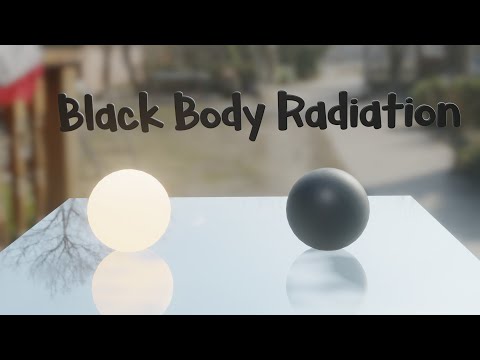
[08:10] Lastly, we should be asking why is it called blackbody radiation?
[08:13] This is called blackbody radiation.
[08:16] This is simply a name assigned to a theoretical material that could absorb every single wavelength.
[08:18] In reality, all materials either reflect or let some wavelengths pass directly through them.
[08:23] And since we associate the color black with the absorption of visible light, we call a material that could theoretically absorb all light black as well.
[08:34] So when we measure the radiation from an object, some of it is reflected and transmitted.
[08:41] But blackbody radiation is the radiation that comes specifically from the object itself.
[08:47] Therefore, when we heat an object up, more and more of that observed radiation comes from the object itself, and that is blackbody radiation.
[09:00] you