youtube-transcript.ai

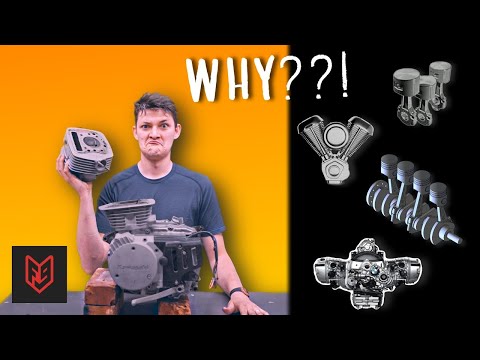
The Pros and Cons of Every Motorcycle Engine Type

Watch with subtitles, summary & AI chat
Add the free Subkun extension — works directly on YouTube.
  • Watch
  • Subtitles
  • Summary
  • Ask AI
Try free →

This video explores the advantages and disadvantages of various motorcycle engine types, from simple singles to complex inline-sixes and V4s, analyzing their cost, performance, sound, vibration, and packaging. The discussion highlights how engine design impacts a motorcycle's character and suitability for different riding styles and terrains.

Full Transcript

https://www.youtube.com/watch?v=aOTz0Ol8fLA

[00:00] Hello.
[00:03] This is why you should seek or avoid each type of engine.
[00:14] Foundationally, we have our single one piston and one cylinder.
[00:20] The biggest benefit is cost.
[00:23] I only need one carburetor, one cylinder head, one valve train, one exhaust system.
[00:28] And short of sticking a Roman candle up your butt, this is as cheap as internal combustion gets.
[00:42] I choose singles when I'm buying old pieces of [ __ ] because this hides very few surprises.
[00:51] Another benefit is long power gaps.
[00:54] Four strokes only make boom on one of four strokes or 180° of the 720° crankshaft cycle.
[00:59] Meaning singles
[01:02] 720° crankshaft cycle.
[01:05] Meaning singles have 540° have 540° of silence and they go bang rest bang of silence and they go bang rest bang.
[01:09] at the rear wheel in top gear.
[01:13] rest. at the rear wheel in top gear.
[01:16] That might only be one power pulse per revolution of the tire, giving your
[01:19] rubber all this time to recover grip.
[01:24] So, singles make the best dirt bikes.
[01:26] Twist your wrist and you'll slide the tire for one fraction of one revolution,
[01:31] making it forgiving to feel the edge of traction since you won't lose the whole
[01:33] tire at once.
[01:35] However, it sounds like a lawn mower.
[01:38] The cadence thump thump thump is why
[01:41] singles are nicknamed thumpers.
[01:45] Another downside is vibration.
[01:53] We have one piston moving up and down, one counterwe moving down and up.
[01:56] So, we're left playing shake the weight for an
[02:04] Left playing shake the weight for an aft.
[02:06] And this is why singles shake a lot and generally can't exceed 7,000 RPM without rattling to pieces.
[02:11] And there are also limits on how big a piston can get before falling apart.
[02:13] So singles tend to top out around 650 cc's.
[02:19] At 7,000 RPM, that's very slow.
[02:22] To go faster, we must increase capacity by adding more cylinders.
[02:28] The easiest and oldest method being the V Twin.
[02:36] See, our pistons attack from two angles.
[02:38] So, we can use the same crank pin on the same crankshaft, but get double the power.
[02:43] Early V twins weren't even bulkier than singles, only 20° between cylinders.
[02:48] However, modern big boore engines use wide pistons, and their skirts crack into each other at bottom dead center.
[02:57] So the V had to widen and widen.
[03:03] Today's V's are usually 50° apart or
[03:06] Today's V's are usually 50° apart or more.
[03:09] Ducati famously calls their 90° jobs L twins.
[03:19] Such spacing means we need two discrete fueling systems, two cylinder heads, two valve trains, two cam drives, double friction loss, double complexity, double cost.
[03:33] And there's worse.
[03:33] To snorkel air between your cylinders kills half your fuel tank volume.
[03:38] And think of the heat.
[03:39] And how are we to keep a fresh charge cool when it's wedged between two pistons?
[03:43] How are we to prevent the rear cylinder overheating when it's sheltered behind the front?
[04:06] It's an inescapably awkward shape to fit
[04:09] It's an inescapably awkward shape to fit in a motorcycle.
[04:11] And there's free space I have but can't really use and filled space I wish I could use for the swing arm pivot but can't.
[04:16] So V twins tend to get really long and cruiser bikes that prefer straight roads.
[04:25] After a complete circle of the city, the racer who returns first before the record stops wins the right to seek the prize.
[04:35] Enter the narrow mazeways of London, where Brits pioneer something more compact, the inline twin with two pistons side by side.
[04:43] Inline twins are horizontally short.
[04:46] Also, we can once again use one head, one valve train, one cam drive.
[04:54] The intakes are all on the right side, the exhaust all naturally on the other.
[04:59] There's reason inline twins the most used motorcycle engines.
[05:05] However, because the pistons are side by side, inline twins necessitate a longer crankshaft with
[05:09] necessitate a longer crankshaft with separate crank pins.
[05:22] Like a fat kid approaching the teeter totter, we're staring down a significant balance problem.
[05:30] Your first thought is to fire the twins 180° apart.
[05:32] So when one piston flies up, the other flies down.
[05:34] Seems balanced.
[05:38] And it is in one axis.
[05:41] See, look.
[05:44] The pistons act on different points of the crankshaft.
[05:46] So while one pulls up here, the other one pushes down here.
[05:50] Rock, rock, rock, rock.
[06:01] It's called a rocking couple.
[06:03] Now, what's annoyingly buzzy on a motorcycle can be catastrophic on a wooden airplane.
[06:08] It was a a bad show to have crashed an
[06:10] It was a a bad show to have crashed an aircraft.
[06:11] aircraft.
[06:11] So, World War I aero engineer Max Fritz built boxer twins.
[06:14] Two pistons punching straight at each other.
[06:17] You can see that the piston forces are inherently balanced.
[06:19] And because the heads don't have to clear each other, they can act on very nearly the same point of the crankshaft.
[06:21] No rocking couple.
[06:23] And since the cylinders are flat, it's easier to pump oil into the engine.
[06:25] Less fighting gravity, free horsepower.
[06:27] The pros stack up compellingly if you have a 40ft wingspan.
[06:31] BMW famously had to bribe Max with a coal stove in war ravage Germany to even consider putting a boxer twin on a motorcycle.
[06:32] It's an illogical choice for carving corners or cutting through trees and must be fueled with the tears of engineers.
[06:35] But boxers became iconic for the more mature riders and remained so largely because the low center of
[07:11] largely because the low center of gravity makes it easy for old men to pick up off a sidestand.
[07:37] Next on my list of engines is the inline triple.
[07:42] Three ducks in a row.
[07:42] And if you look carefully, you'll notice at least one piston is always moving.
[07:47] See, on singles and twins, there's a moment of dead stop either at top dead center, bottom dead center, or one of each.
[07:54] No piston is moving.
[07:54] Now, we call this inertial imbalance because it makes the crankshaft go whoosh, speeding and slowing every rotation.
[08:17] But on a triple, if this piston is stopped, these two are moving.
[08:19] If this piston is stopped, these two are moving.
[08:21] piston is stopped, these two are moving.
[08:23] momentum is equalized across the crankshaft so it can spool up faster
[08:25] crankshaft so it can spool up faster hitting higher revs.
[08:37] We know power is proportional to the multiple of RPM.
[08:43] So triples can hit the highest horsepower yet.
[08:45] And as the Jehovah's Witnesses would say, you've now heard the good news
[08:49] because the rest is bad.
[08:52] Three is an uneven number of cylinders, and a
[08:53] three-legged dog will never hump smoothly.
[08:55] We could balance it in Y, and that would [ __ ] up X.
[09:01] We could balance it in X, and oh, that would ruin Y.
[09:05] Add one balancer shaft, 2, 10, it doesn't freaking matter.
[09:07] Triples will always shake and that annoys the perfectionist
[09:09] in me.
[09:11] So, let's one up to the inline
[09:15] in me.
[09:15] So, let's one up to the inline four, a nice even number.
[09:18] Remember our four, a nice even number.
[09:18] Remember our 720° cycle divided by four cylinders and then
[09:23] cycle divided by four cylinders and then subtract the 180° length of a power stroke to get zero as in zero time that
[09:30] stroke to get zero as in zero time that the crankshaft is not receiving power.
[09:33] the crankshaft is not receiving power.
[09:33] Zero silence.
[09:36] And for the first time, it's not bum bum bum, it's
[09:46] which is why inline fours are nicknamed
[09:49] which is why inline fours are nicknamed screamers.
[09:52] [Music]
[09:56] [Applause]
[09:57] [Applause]
[09:57] Screamers balance all pistons and both rocking couples, so they can spin
[10:02] rocking couples, so they can spin extremely fast.
[10:04] extremely fast.
[10:04] It's maximal power per displacement.
[10:08] displacement.
[10:08] However, there is one significant con.
[10:12] A sneaky
[10:15] there is one significant con. A sneaky little called secondary imbalance.
[10:18] little called secondary imbalance.
[10:21] Here's our piston on our crank. top dead center and then 90° and then bottom dead center.
[10:24] center and then 270° and then top again.
[10:27] But because Pythagoras was a little called secondary imbalance.
[10:30] this height, it's not actually halfway.
[10:32] It's a little bit less than half.
[10:35] So our piston must move faster to get here and slower to get there.
[10:39] slower to get there. Slower again to get there and faster again to get back up there.
[10:42] there and faster again to get back up there.
[10:45] there.
[10:47] That means some force must exist at midstroke to change the piston velocity versus top and bottom.
[10:49] midstroke to change the piston velocity versus top and bottom.
[10:52] Well, Inline fours have the worst possible secondary imbalance then.
[10:56] Inline fours have the worst possible secondary imbalance then.
[10:59] It's not fatal. Engineers just add a balancer shaft to fix it.
[11:02] fatal. Engineers just add a balancer shaft to fix it.
[11:04] But geeks hate moving weight around for the sake of moving weight around.
[11:06] shaft to fix it. But geeks hate moving weight around for the sake of moving weight around.
[11:08] weight around. It's why I never go to the gym.
[11:10] weight around. It's why I never go to the gym.
[11:12] the gym. Our only solution is the unicorn. the
[11:16] Our only solution is the unicorn.
[11:16] The unattainable, the inline 6.
[11:19] We're unattainable, the inline 6.
[11:19] We're talking Honda CBX.
[11:22] We're talking Honda CBX.
[11:22] We're talking Kawasaki Z1300.
[11:25] Kawasaki Z1300.
[11:25] We're talking Penelli say a song sung but three times.
[11:29] We're talking Penelli say a song sung but three times.
[11:32] A song sung but three times that still rings in our ears.
[11:37] That still rings in our ears.
[11:37] Do you hear the theoretical perfection?
[11:39] Do you hear the theoretical perfection?
[11:39] Our inline 6 is the smallest possible engine with perfect balance.
[11:42] Our inline 6 is the smallest possible engine with perfect balance.
[11:42] All primary forces, all rocking couples, all secondary forces are naturally neutral.
[11:46] All primary forces, all rocking couples, all secondary forces are naturally neutral.
[11:48] All primary forces, all rocking couples, all secondary forces are naturally neutral.
[11:48] Even the crankcase volume stays continuous so as not to incur pumping losses compressing air.
[11:52] Even the crankcase volume stays continuous so as not to incur pumping losses compressing air.
[11:54] Even the crankcase volume stays continuous so as not to incur pumping losses compressing air.
[11:56] But, and this is a wide beratric but, we are back to the boxer problem.
[11:59] But, and this is a wide beratric but, we are back to the boxer problem.
[12:03] What is the point of having a lovely engine that turns into a road crayon at 30° of lean?
[12:06] What is the point of having a lovely engine that turns into a road crayon at 30° of lean?
[12:08] Let's take a step back and rearrange our inline four into a V4.
[12:11] Let's take a step back and rearrange our inline four into a V4.
[12:14] Let's take a step back and rearrange our inline four into a V4.
[12:19] Rearrange our inline four into a V4.
[12:21] I admit the secondary forces don't cancel, but because of the V angle,
[12:23] well, they don't add 1:1 either.
[12:25] It's more like 1 + 1 equals 1.4.
[12:29] We have a smaller rocking force acting on a shorter crankshaft.
[12:35] And because sequential pistons are now on opposite sides of the engine, we can use large bores without needing a long block.
[12:45] I'll stand behind a bold statement.
[12:48] The V4 is the best engine for a motorcycle, period.
[12:51] Near-perfect balance allowing for 20,000 RPM big bore power in a conveniently sized square.
[13:01] Just look at the Moto GP grid.
[13:05] Ducatti, Arillia, KTM, Honda.
[13:10] 20 of the 22 fastest motorcycles in the world run V4s.
[13:21] However,
[13:23] However, those motorcycles cost $1.5 million.
[13:27] And those motorcycles cost $1.5 million.
[13:30] And to fit four pistons on half the crankshaft requires crepe thin webs and bearings.
[13:33] And to get that, you basically have to employ magneto machine them from adamantium.
[13:35] adamantium.
[13:37] Honda once spent for their VFR, Yamaha for their V-Max, Ducati's Pennal, Arillia's RSV, but they're generally unobtanium, so if you get a chance to own a V4, do it.
[13:43] Honda once spent for their VFR, Yamaha
[13:45] for their V-Max,
[13:48] Ducati's Pennal,
[13:51] Arillia's RSV,
[13:54] but they're generally unobtanium, so if you get a chance to own a V4, do it.
[13:57] Singles are for saving money and riding dirt.
[13:59] V Twins add power if you don't mind adding length.
[14:01] Inline twins kind of lope along and sound like a sewing machine, unless it's one of the new 270 degree jobs.
[14:04] Inline twins kind of
[14:06] lope along and sound like a sewing
[14:08] machine, unless it's one of the new 270
[14:11] degree jobs. Boxers are dumb.
[14:13] Inline triples are inherently unbalanced.
[14:15] You'll see these marketed as raw engines.
[14:17] But if I sold you a raw hamburger, would that be desirable?
[14:20] Inline fours are the first true
[14:21] Inline fours are the first true screamers.
[14:24] Constant power being a better screamers.
[14:26] Constant power being a better way to rev fast, though you'll need a balancer shaft.
[14:28] And inline sixes are theoretical perfection, but realistically impractical.
[14:32] We've been gradually adding width and cost.
[14:36] And this is the point of diminishing return.
[14:40] Thank you very much for watching.
[14:42] And yes, I left a few engines out.
[14:44] I can't talk about them all at once anymore than I could ride them all at once, which is why VO deserves your attention.
[14:51] VO is an insurance provider that offers payper mile coverage.
[14:55] You snap a photo of your odometer each month and pay just for the distance traveled.
[15:00] And why hold full-size insurance policies for multiple part-time bikes or even for one bike if you ride less than 2,000 miles a year?
[15:09] Click the link below and make a quote.
[15:10] If you live in one of these states, you could save up to 60% on motorcycle insurance right now.
[15:14] Click the link, make a quote, and see what you get.
[15:19] [Music]

Cite this page

If you're using ChatGPT, Claude, Gemini, or another AI assistant, paste this URL into the chat:

https://youtube-transcript.ai/docs/the-pros-and-cons-of-every-motorcycle-engine-type-303ngkssan

The full transcript and summary on this page will be retrieved as context, so the assistant can answer questions about the video accurately.