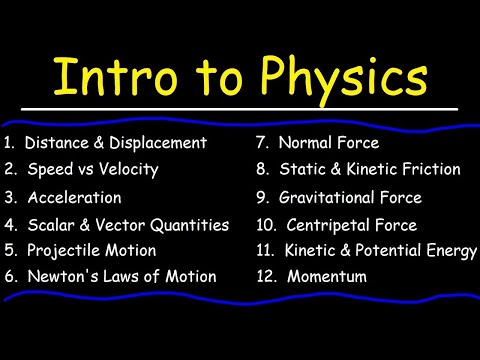
Physics - Basic Introduction
https://www.youtube.com/watch?v=b1t41Q3xRM8
[00:02] in this video we're going to cover some basic concepts such as displacement velocity acceleration projectile motion newton's three laws forces momentum and things like that.
[00:17] so for those of you who want a basic intro into physics and just want to understand some principle ideas involving physics this video is for you.
[00:25] so let's begin the first thing we're going to talk about is distance and displacement.
[00:36] now many of you out there are very familiar with the word distance.
[00:40] when you think of distance when you hear the word distance what do you think of.
[00:44] i think of how far something has traveled.
[00:49] so let's say the distance between one city to another could be a hundred miles and so is the the difference between two points.
[00:58] now displacement is very similar to
[01:02] now displacement is very similar to distance but distance but displacement
[01:06] displacement encompasses direction as well encompasses direction as well direction is important for displacement
[01:13] direction is important for displacement so let me give an example that distinguishes distance and displacement
[01:18] distinguishes distance and displacement so let's say if you have a person let's say john
[01:22] let's say john and he's at this position right here and he decides to walk let's say eight meters east
[01:30] eight meters east and then he turns in the other direction and travels let's say three meters west
[01:40] west the total distance that john travels is eight plus three or eleven meters
[01:46] eight plus three or eleven meters however his displacement is not eleven but rather his displacement
[01:52] displacement is five meters
[01:59] displacement is the difference between the final position
[02:02] position and the initial position.
[02:05] and the initial position so let's say if we have a number line.
[02:09] so let's say if we have a number line and let's say this is position zero.
[02:13] and let's say this is position zero so john traveled.
[02:14] so john traveled eight meters east.
[02:17] eight meters east so now he's at position.
[02:20] so now he's at position eight on a number line.
[02:25] so during the first part of his trip his.
[02:27] so during the first part of his trip his displacement was positive eight.
[02:31] then he traveled.
[02:34] then he traveled three meters.
[02:35] three meters west.
[02:37] west so his displacement is negative three.
[02:40] so his displacement is negative three so now he's at position five.
[02:44] so now he's at position five and so his.
[02:45] and so his net displacement.
[02:48] net displacement is five meters because he started from.
[02:50] is five meters because he started from position a and now he's at position b.
[02:53] position a and now he's at position b which is located at position five.
[02:57] which is located at position five and so your net displacement is.
[02:59] and so your net displacement is basically.
[03:01] basically it's the final position let's say pf.
[03:04] it's the final position let's say pf minus the initial position.
[03:06] minus the initial position his final position is position five.
[03:09] his final position is position five his initial position is zero.
[03:11] his initial position is zero so his displacement is positive five.
[03:14] so his displacement is positive five he went from a to b.
[03:16] he went from a to b and so that's the basic idea behind.
[03:17] and so that's the basic idea behind displacement.
[03:19] displacement the total distance is 11.
[03:22] the total distance is 11. now distance is a scalar quantity.
[03:27] now distance is a scalar quantity it only has magnitude.
[03:30] it only has magnitude displacement is a vector quantity.
[03:32] displacement is a vector quantity it has both magnitude and direction.
[03:36] it has both magnitude and direction in the case of distance.
[03:38] in the case of distance in the first part of the trip he.
[03:40] in the first part of the trip he traveled a distance of positive eight in.
[03:42] traveled a distance of positive eight in the second part he traveled a distance.
[03:45] the second part he traveled a distance of positive three and so the total.
[03:47] of positive three and so the total distance is 11 meters.
[03:51] distance is 11 meters now displacement has the magnitude and.
[03:54] now displacement has the magnitude and direction.
[03:56] direction during the first part of his trip.
[03:59] during the first part of his trip his displacement was positive eight.
[04:02] his displacement was positive eight the magnitude is.
[04:04] the magnitude is how far he traveled which is eight.
[04:05] how far he traveled which is eight meters.
[04:07] meters the direction is he's traveling east.
[04:10] the direction is he's traveling east and so we have a positive sign for going.
[04:12] and so we have a positive sign for going in an eastward direction.
[04:14] in an eastward direction anytime you go towards the right you're.
[04:17] anytime you go towards the right you're going in the positive x direction.
[04:19] going in the positive x direction so the displacement is positive.
[04:22] so the displacement is positive now during the second part of the trip.
[04:24] now during the second part of the trip he's traveling west.
[04:26] he's traveling west that is towards the negative x direction.
[04:30] that is towards the negative x direction and so it's negative 3 in terms of.
[04:32] and so it's negative 3 in terms of displacement but in terms of distance.
[04:34] displacement but in terms of distance it's positive 3. keep this in mind.
[04:37] it's positive 3. keep this in mind distance is always positive but.
[04:39] distance is always positive but displacement can be positive or negative.
[04:43] displacement can be positive or negative if you're traveling east.
[04:45] if you're traveling east or north.
[04:47] or north displacement has a positive value.
[04:50] displacement has a positive value if you're traveling west or south.
[04:53] if you're traveling west or south displacement has a negative.
[04:54] displacement has a negative value and so if you add up the.
[04:57] value and so if you add up the displacement for the first part of the.
[04:58] displacement for the first part of the trip.
[04:59] trip plus the displacement of the second part.
[05:02] plus the displacement of the second part you get the net displacement of positive.
[05:04] you get the net displacement of positive five.
[05:05] five positive eight.
[05:06] positive eight plus negative three will give you positive five.
[05:08] plus negative three will give you positive five.
[05:11] positive five now let's say a car.
[05:14] now let's say a car travels 200 miles.
[05:17] 200 miles would this description be related to distance or displacement?
[05:22] be related to distance or displacement so if i say you travel 200 miles am i describing distance or displacement?
[05:28] so if i say you travel 200 miles am i describing distance or displacement?
[05:32] well this would be a description of distance.
[05:34] well this would be a description of distance.
[05:35] distance because no direction was indicated.
[05:38] because no direction was indicated so you could be going east west north or south.
[05:40] so you could be going east west north or south.
[05:41] south if you simply state 200 miles you're describing distance.
[05:44] if you simply state 200 miles you're describing distance.
[05:45] describing distance now let's say if the car traveled 300 miles north.
[05:48] now let's say if the car traveled 300 miles north.
[05:49] miles north in this case i have the magnitude which is 300 miles and i also have the direction which is in the norfolk direction.
[05:53] in this case i have the magnitude which is 300 miles and i also have the direction which is in the norfolk direction.
[05:55] i have the magnitude which is 300 miles and i also have the direction which is in the norfolk direction.
[05:58] and i also have the direction which is in the norfolk direction.
[06:00] which is in the norfolk direction so in this case i'm describing displacement.
[06:03] so in this case i'm describing displacement.
[06:04] so in this case i'm describing displacement.
[06:06] displacement displacement is a vector quantity.
[06:09] displacement is a vector quantity it has both magnitude.
[06:11] it has both magnitude and direction.
[06:12] and direction whereas a distance.
[06:14] whereas a distance is a scalar quantity.
[06:16] is a scalar quantity it only has magnitude such as 200 miles.
[06:20] it only has magnitude such as 200 miles without any direction.
[06:22] without any direction so make sure you understand the.
[06:23] so make sure you understand the difference between a scalar quantity and.
[06:25] difference between a scalar quantity and a vector quantity.
[06:27] a vector quantity a scalar quantity as we said before.
[06:30] a scalar quantity as we said before has magnitude only.
[06:33] has magnitude only but a vector quantity has a magnitude.
[06:36] but a vector quantity has a magnitude and direction.
[06:39] now let's talk about speed.
[06:42] now let's talk about speed when you think of the word speed what do.
[06:43] when you think of the word speed what do you think of.
[06:45] you think of speed tells you how fast something is.
[06:48] speed tells you how fast something is moving.
[06:49] moving so let's say if.
[06:51] so let's say if a car is traveling 30 meters per second.
[06:55] a car is traveling 30 meters per second what does that mean.
[06:57] what does that mean so that means that every second.
[06:59] so that means that every second the car.
[07:00] the car will have traveled a distance of 30.
[07:02] will have traveled a distance of 30 meters.
[07:04] meters so let's say this is the starter line.
[07:07] so let's say this is the starter line and i'm going to use a box to represent
[07:09] and i'm going to use a box to represent a car
[07:10] a car and the car is moving in this direction
[07:12] and the car is moving in this direction with a speed of 30 meters per second
[07:15] with a speed of 30 meters per second so one second later
[07:17] so one second later the car will have traveled a total
[07:19] the car will have traveled a total distance of 30 meters
[07:21] distance of 30 meters two seconds later
[07:23] two seconds later it's going to travel
[07:24] it's going to travel another distance of 30 meters so for a
[07:26] another distance of 30 meters so for a total distance of 60 meters
[07:29] total distance of 60 meters so we can make a table
[07:32] so we can make a table so let's put
[07:33] so let's put t for time
[07:35] t for time d for distance
[07:37] d for distance so if the speed
[07:40] so if the speed is 30 meters per second
[07:43] is 30 meters per second so every second
[07:45] so every second the distance traveled will increase by
[07:48] the distance traveled will increase by 30.
[07:50] 30. and so that's what speed tells us
[07:53] and so that's what speed tells us it tells us how fast the distance
[07:56] it tells us how fast the distance of an object or the distance traveled by
[07:58] of an object or the distance traveled by an object is changing every second
[08:02] an object is changing every second so let's say if you're driving a car and
[08:04] so let's say if you're driving a car and you're going 60 miles per hour
[08:07] you're going 60 miles per hour.
[08:10] every hour at that speed you will travel a distance of 60 miles.
[08:13] a distance of 60 miles so let's say if you want to travel a distance of 300 miles it's gonna take you five hours to do so.
[08:16] distance of 300 miles it's gonna take you five hours to do so.
[08:20] in the first hour you're gonna travel 60 miles.
[08:22] in the first hour you're gonna travel 60 miles.
[08:23] miles in the second hour you have covered a distance of 120 miles.
[08:25] in the second hour you have covered a distance of 120 miles.
[08:27] distance of 120 miles so every hour you're going to travel an additional distance of 60 miles.
[08:30] so every hour you're going to travel an additional distance of 60 miles.
[08:34] now there's a formula that you need to know.
[08:36] now there's a formula that you need to know.
[08:37] know and it's d is equal to vt.
[08:41] and it's d is equal to vt.
[08:43] in this equation d can be used as a distance.
[08:44] d can be used as a distance.
[08:47] can be used as a distance and v represents speed.
[08:49] and v represents speed.
[08:52] represents speed t represents time.
[08:53] t represents time.
[08:56] represents time now sometimes with this formula you could use the velocity in terms of v.
[08:58] now sometimes with this formula you could use the velocity in terms of v.
[09:02] you could use the velocity in terms of v and if you do so then d will no longer technically be represented by distance but it's going.
[09:04] and if you do so then d will no longer technically be represented by distance but it's going.
[09:05] will no longer technically be represented by distance but it's going.
[09:08] represented by distance but it's going to be represented by displacement.
[09:11] to be represented by displacement and so you could use that simple formula.
[09:13] and so you could use that simple formula in many different ways.
[09:14] in many different ways so here's a question for you.
[09:16] so here's a question for you so let's say if you have an object.
[09:19] so let's say if you have an object that is moving.
[09:21] that is moving at a speed of let's say 50 meters per second.
[09:28] 50 meters per second how long will it take for this object to travel a distance of 1000 meters.
[09:38] so we're looking for the time how long so we could use this formula d is equal to vt.
[09:44] so the distance is a thousand meters v is 50 meters per second and we need to calculate the time.
[09:53] so we can divide both sides by 50.
[09:56] and so it's going to be a thousand divided by 50.
[09:58] if we cancel a zero that's a hundred divided by 5 which is 20.
[10:04] so it's going to take 20 seconds for this object to travel a distance.
[10:10] for this object to travel a distance of a thousand meters.
[10:13] now let's talk about speed.
[10:16] now let's talk about speed and velocity.
[10:18] and velocity so what is the difference.
[10:20] so what is the difference between these two quantities.
[10:24] between these two quantities because they both describe how fast.
[10:27] because they both describe how fast something is moving.
[10:29] something is moving but there's a difference between them.
[10:32] but there's a difference between them speed.
[10:33] speed is a scalar quantity.
[10:35] is a scalar quantity and velocity.
[10:37] and velocity is a vector quantity.
[10:41] is a vector quantity speed is always positive velocity can be.
[10:44] speed is always positive velocity can be positive or negative.
[10:46] positive or negative now recall that.
[10:48] now recall that a scalar quantity only has.
[10:50] a scalar quantity only has magnitude.
[10:52] magnitude whereas a vector quantity.
[10:54] whereas a vector quantity has magnitude and direction.
[10:57] has magnitude and direction so can you think of some examples.
[11:00] so can you think of some examples that will distinguish.
[11:02] that will distinguish speed from velocity.
[11:06] speed from velocity so let's say if a train.
[11:08] so let's say if a train i'm going to use a box again.
[11:10] i'm going to use a box again is moving.
[11:11] is moving at
[11:12] at 45 meters per second
[11:16] let me take away the arrow
[11:19] let me take away the arrow so i you don't have any direction it's
[11:21] so i you don't have any direction it's simply moving at 45 meters per second
[11:24] simply moving at 45 meters per second in this case
[11:26] in this case this describes the speed of the train
[11:29] this describes the speed of the train because i'm telling you how fast it's
[11:31] because i'm telling you how fast it's moving but not where it's going
[11:34] moving but not where it's going now let's say if we have a train
[11:36] now let's say if we have a train moving at 30 meters per second
[11:39] moving at 30 meters per second going
[11:40] going west in this case this is a description
[11:44] west in this case this is a description of velocity
[11:45] of velocity because
[11:47] because not only do you have the magnitude of
[11:49] not only do you have the magnitude of the vector which is the speed
[11:51] the vector which is the speed but you also have the direction
[11:54] but you also have the direction and so when you combine magnitude and
[11:56] and so when you combine magnitude and direction
[11:58] direction you have a vector quantity and so
[12:00] you have a vector quantity and so velocity
[12:01] velocity is basically
[12:02] is basically speed with direction the 30 meters per
[12:05] speed with direction the 30 meters per second tells you the speed
[12:08] second tells you the speed wes tells you the direction
[12:10] wes tells you the direction and when you combine these two
[12:13] and when you combine these two you have velocity
[12:16] you have velocity so let's summarize a few key points
[12:20] so let's summarize a few key points speed
[12:21] speed tells you how fast something is moving
[12:25] tells you how fast something is moving velocity
[12:26] velocity tells you
[12:28] tells you not only how fast something is moving
[12:30] not only how fast something is moving but also
[12:32] but also where it is going
[12:34] where it is going so remember velocity is speed with
[12:36] so remember velocity is speed with direction
[12:37] direction speed can only be positive
[12:39] speed can only be positive velocity can be positive or negative
[12:44] so if v is negative 20 meters per second
[12:48] so if v is negative 20 meters per second you know you're dealing with velocity
[12:50] you know you're dealing with velocity because it's negative
[12:52] because it's negative if you're looking for the speed
[12:54] if you're looking for the speed the speed would be positive 20 meters
[12:56] the speed would be positive 20 meters per second speed is always positive
[13:00] per second speed is always positive and you could say this speed
[13:02] and you could say this speed is the absolute value of velocity
[13:06] is the absolute value of velocity velocity can be positive or negative but
[13:08] velocity can be positive or negative but speed is always positive
[13:11] speed is always positive so if the velocity was negative 35
[13:13] so if the velocity was negative 35 meters per second the speed is meters per second the speed is automatically positive 35 meters per
[13:18] automatically positive 35 meters per second
[13:21] now there are some mathematical formulas
[13:23] now there are some mathematical formulas that you want to know when dealing with
[13:26] that you want to know when dealing with speed and velocity
[13:30] there's something called average speed
[13:35] there's something called average speed because sometimes in physics you need to
[13:37] because sometimes in physics you need to calculate the average speed of an object
[13:41] calculate the average speed of an object the average speed
[13:42] the average speed can be calculated by taking the total
[13:44] can be calculated by taking the total distance
[13:45] distance traveled by the object and dividing it
[13:49] traveled by the object and dividing it by the total time
[13:53] now
[13:54] now if you think about this formula d is
[13:56] if you think about this formula d is equal to vt
[13:58] equal to vt v can be described as the speed or the
[14:00] v can be described as the speed or the velocity so if you divide both sides by
[14:03] velocity so if you divide both sides by t
[14:05] t you could cancel this on the right side
[14:07] you could cancel this on the right side you'll see that v
[14:09] you'll see that v which is
[14:10] which is the average speed in this case is equal
[14:12] the average speed in this case is equal to d over t
[14:15] to d over t so average speed v is equal to the total.
[14:18] so average speed v is equal to the total distance d divided by the total time t.
[14:24] now what about average velocity?
[14:28] now what about average velocity let's say if we wish to calculate.
[14:30] let's say if we wish to calculate average velocity how can we do so?
[14:34] average velocity how can we do so average velocity.
[14:35] average velocity is equal.
[14:37] is equal to displacement.
[14:39] to displacement divided by the total time.
[14:43] divided by the total time so in this case the formula looks the.
[14:45] so in this case the formula looks the same.
[14:46] same average velocity could be represented by.
[14:48] average velocity could be represented by v.
[14:49] v displacement can be represented by d.
[14:51] displacement can be represented by d and the time is t.
[14:54] and the time is t so the formula.
[14:56] so the formula looks.
[14:57] looks identical but the meaning is different.
[15:01] identical but the meaning is different so keep this in mind velocity is.
[15:03] so keep this in mind velocity is associated with displacement.
[15:06] associated with displacement speed.
[15:07] speed is associated with distance.
[15:12] now let's say if you have an object.
[15:16] now let's say if you have an object and this object traveled
[15:18] and this object traveled 12 meters
[15:20] 12 meters east
[15:21] east and then
[15:23] and then it travels
[15:25] it travels 20 meters
[15:27] 20 meters west
[15:28] west and it did so in a time period
[15:31] and it did so in a time period a total time period
[15:33] a total time period of four seconds
[15:34] of four seconds so let's say
[15:36] so let's say going from position a to position b
[15:39] going from position a to position b that's a distance of 12 meters and from
[15:41] that's a distance of 12 meters and from position b to position c
[15:44] position b to position c 20 meters
[15:45] 20 meters so that total trip from a to c
[15:48] so that total trip from a to c took only four seconds
[15:52] so for this object going from a to c
[15:56] so for this object going from a to c what is the average speed of the object
[15:59] what is the average speed of the object and also what is the average velocity
[16:04] so to calculate the average speed
[16:08] so to calculate the average speed we need to determine the total distance
[16:11] we need to determine the total distance and divide it by the total time
[16:13] and divide it by the total time the total distance is simply 12
[16:16] the total distance is simply 12 plus 20.
[16:18] plus 20.
[16:18] if you add those two numbers it will give you 32 meters.
[16:25] and the total time is 4 seconds.
[16:28] is 4 seconds so 32 divided by 4 is 8.
[16:32] so the average speed is positive 8.
[16:35] keep in mind speed is always positive.
[16:39] now what about the average velocity.
[16:43] well we know that average velocity is defined as displacement divided by the total time.
[16:52] the displacement for the first part of the trip going from a to b is positive 12 because the object is traveling in the positive x direction.
[17:04] the object is going east for the second part of the trip.
[17:06] the object is traveling west towards the negative x direction.
[17:13] and so going from b to c the displacement is negative.
[17:17] displacement is negative so if we add up.
[17:19] so if we add up 12 and negative 20.
[17:22] 12 and negative 20 we can get the net displacement which is negative eight.
[17:28] now keep in mind you can also treat this as a number line let's say a is at position 0.
[17:34] position 0 b will be at position 12.
[17:37] and then if you do 12 minus 20 you'll see that c is at position negative 8.
[17:43] and the difference between these two positions will be the net displacement which is still negative eight.
[17:51] eight so the final position minus the initial position will give you the net displacement.
[17:58] now let's divide it by four seconds so the average velocity is negative two meters per second.
[18:05] and it makes sense because the net result is that the person traveled in the in the westward direction towards the negative x-axis so going from a to c.
[18:18] going from a to c ignoring b.
[18:19] ignoring b the person traveled.
[18:21] the person traveled towards the west.
[18:23] towards the west and that's why the velocity is negative.
[18:25] and that's why the velocity is negative because.
[18:26] because any time you're going in the west.
[18:27] any time you're going in the west direction towards the negative x-axis it.
[18:29] direction towards the negative x-axis it will be negative.
[18:30] will be negative if you're going towards the positive.
[18:32] if you're going towards the positive x-axis or in the eastward direction.
[18:35] x-axis or in the eastward direction it's going to be positive.
[18:39] now let's talk about.
[18:41] now let's talk about acceleration.
[18:43] acceleration what is acceleration.
[18:50] now you've encountered acceleration when.
[18:53] now you've encountered acceleration when driving a car.
[18:54] driving a car a good way to think about it is.
[18:57] a good way to think about it is imagine two vehicles.
[18:59] imagine two vehicles let's say.
[19:01] let's say a truck.
[19:08] i'm not the most artistic.
[19:11] i'm not the most artistic person but.
[19:12] person but we'll work with this and let's say a.
[19:15] we'll work with this and let's say a sports car.
[19:19] which of these two vehicles, which of these two vehicles have, let's say, a greater acceleration? Is it the truck, the truck or the sports car?
[19:32] So what is acceleration? Acceleration tells you how fast the speed is changing, or more technically, how fast the velocity is changing.
[19:45] So the truck can probably go from zero to 60 miles and maybe, let's say, 30 seconds.
[19:55] A sports car can go from 0 to 60 in a shorter period of time, let's say in 5 seconds.
[20:04] So because the sports car can get to a higher speed or to a certain speed faster than the truck, it has a greater acceleration.
[20:15] And so acceleration tells you how fast the velocity is.
[20:20] tells you how fast the velocity is changing.
[20:23] acceleration.
[20:25] acceleration is defined as the change in velocity.
[20:29] is defined as the change in velocity divided by the change in time.
[20:31] divided by the change in time or sometimes you could just put t.
[20:35] or sometimes you could just put t so you can write it this way.
[20:37] so you can write it this way let me adjust the formula so if you see.
[20:39] let me adjust the formula so if you see the triangle it simply means change.
[20:42] the triangle it simply means change so acceleration.
[20:43] so acceleration can be written this way it's the final.
[20:45] can be written this way it's the final velocity.
[20:47] velocity minus the initial velocity divided by.
[20:49] minus the initial velocity divided by the time.
[20:50] the time so to calculate the acceleration of the.
[20:52] so to calculate the acceleration of the truck.
[20:53] truck notice that the change in velocity is 60.
[20:56] notice that the change in velocity is 60 60 minus zero.
[20:58] 60 minus zero is 60.
[21:00] is 60 divided by the time which is 30. so 60.
[21:03] divided by the time which is 30. so 60 divided by 30 is 2.
[21:05] divided by 30 is 2. so the acceleration of this truck.
[21:08] so the acceleration of this truck is.
[21:09] is 2.
[21:11] 2 miles.
[21:12] miles per hour.
[21:13] per hour per second.
[21:15] per second because we divided miles per hour by.
[21:18] because we divided miles per hour by seconds so it's miles per hour per.
[21:20] seconds so it's miles per hour per second.
[21:22] second now the acceleration of the sports car.
[21:24] now the acceleration of the sports car is 60 miles per hour that's the change.
[21:27] is 60 miles per hour that's the change in velocity divided by five seconds 60.
[21:30] in velocity divided by five seconds 60 divided by 5 is 12.
[21:32] divided by 5 is 12.
[21:34] so it's 12 miles per hour per second.
[21:37] miles per hour per second as you can see.
[21:39] as you can see the acceleration of the sports car.
[21:42] the acceleration of the sports car is much greater than the acceleration of.
[21:45] is much greater than the acceleration of the truck.
[21:46] the truck the truck is going to take a long time.
[21:48] the truck is going to take a long time to go from 0 to 60 but the sports car.
[21:51] to go from 0 to 60 but the sports car will get there a lot faster and so it.
[21:54] will get there a lot faster and so it has a greater acceleration.
[21:57] has a greater acceleration and so that's the basic idea behind.
[21:59] and so that's the basic idea behind acceleration it tells you.
[22:01] acceleration it tells you how fast the velocity is changing.
[22:05] how fast the velocity is changing now let's make a table.
[22:07] now let's make a table let's say if an object is moving.
[22:10] let's say if an object is moving with an initial speed.
[22:13] with an initial speed of.
[22:14] of 12 meters per second.
[22:16] 12 meters per second so vo tells you initial speed or.
[22:19] so vo tells you initial speed or initial velocity.
[22:21] Initial velocity now since I have an arrow let's say it's going east.
[22:22] Now since I have an arrow let's say it's going east.
[22:24] Going east this now is it becomes the description of velocity.
[22:25] This now is it becomes the description of velocity.
[22:28] It becomes the description of velocity if I put direction with it.
[22:31] If I put direction with it and let's say at this point this object or vehicle begins to accelerate.
[22:33] And let's say at this point this object or vehicle begins to accelerate.
[22:35] This object or vehicle begins to accelerate.
[22:37] Begins to accelerate at a rate of 4 meters per second squared.
[22:39] At a rate of 4 meters per second squared so this is 4 meters per second per second.
[22:42] 4 meters per second squared so this is 4 meters per second per second.
[22:45] Meters per second per second so what does that mean.
[22:47] So what does that mean.
[22:49] So if we make a table if we plot time and velocity.
[22:51] If we plot time and velocity let's say the final velocity at a certain time.
[22:53] And velocity let's say the final velocity at a certain time at t equals 0.
[22:55] Let's say the final velocity at a certain time.
[22:56] Certain time at t equals 0.
[22:58] At t equals 0 this becomes the initial velocity so it's 12.
[23:00] This becomes the initial velocity so it's 12.
[23:02] It's 12. What would the velocity be one second later.
[23:05] What would the velocity be one second later.
[23:07] Later well the acceleration tells us how fast the velocity is changing.
[23:10] Well the acceleration tells us how fast the velocity is changing.
[23:11] How fast the velocity is changing.
[23:13] The velocity is changing so because the acceleration is positive 4 that means that the velocity is increasing by 4 meters per second.
[23:16] So because the acceleration is positive 4 that means that the velocity is increasing.
[23:16] 4 that means that the velocity is increasing.
[23:19] That means that the velocity is increasing by 4 meters per second.
[23:20] Increasing by 4 meters per second.
[23:22] by 4 meters per second every second.
[23:23] every second so anytime acceleration is positive.
[23:26] so anytime acceleration is positive the velocity is increasing.
[23:28] the velocity is increasing any time the acceleration is negative.
[23:31] any time the acceleration is negative the velocity is decreasing.
[23:34] the velocity is decreasing so one second later the velocity will.
[23:37] so one second later the velocity will now be 16.
[23:38] now be 16. two seconds later the velocity is 20.
[23:41] two seconds later the velocity is 20. three seconds later it's 24 four seconds.
[23:45] three seconds later it's 24 four seconds later.
[23:46] later it's 28.
[23:48] it's 28 and so every second the velocity will.
[23:50] and so every second the velocity will increase by 4 meters per second because.
[23:53] increase by 4 meters per second because the acceleration is 4 meters per second.
[23:56] the acceleration is 4 meters per second per second.
[23:59] per second now.
[24:00] now the formula that you want to use to.
[24:01] the formula that you want to use to calculate final velocity.
[24:03] calculate final velocity is this equation v final is equal to v.
[24:06] is this equation v final is equal to v initial plus 80.
[24:11] now let's say we have another object.
[24:14] now let's say we have another object that.
[24:15] that is moving in an eastward direction at a.
[24:18] is moving in an eastward direction at a speed of let's say.
[24:21] speed of let's say 24 meters per second.
[24:24] 24 meters per second but this time let's say the acceleration is negative 6.
[24:28] is negative 6 meters per second squared.
[24:30] meters per second squared what's going on here.
[24:34] is this object speeding up or slowing.
[24:37] is this object speeding up or slowing down.
[24:40] whenever the acceleration and velocity whenever they have opposite signs the object is slowing down.
[24:47] object is slowing down whenever they have the same sign it's speeding up.
[24:51] speeding up in the last example the acceleration was positive 4 and the velocity had positive values.
[24:58] it started with positive 12 and so because velocity and acceleration have the same sign the object was speeding up.
[25:10] so you may want to write this down.
[25:14] the object will be speeding up.
[25:17] the object will be speeding up that is the speed will be increasing if acceleration and velocity have the same signs if they're both positive.
[25:26] same signs if they're both positive or or if they're both negative.
[25:30] if they're both negative the object will be slowing down.
[25:36] if the acceleration and velocity if the acceleration and velocity have opposite signs.
[25:41] have opposite signs either positive either positive and negative or and negative or negative and positive.
[25:46] negative and positive and this example will illustrate that.
[25:52] so this time so this time we're going to make a table with time.
[25:57] we're going to make a table with time velocity and i'm going to use s for speed or sp for speed.
[26:05] so at t equals 0 the velocity is positive 24.
[26:10] and remember speed is the absolute value of velocity so the speed is positive 24.
[26:19] now one second later what will be the new velocity well the acceleration is negative six.
[26:27] well the acceleration is negative six and recall that if acceleration is negative the velocity will be decreasing.
[26:33] negative the velocity will be decreasing so it's going to decrease by six.
[26:36] by six so 24 minus 6 is 18.
[26:40] so 24 minus 6 is 18. two seconds later it will be 12.
[26:45] three seconds later it's going to be six four seconds later it's zero.
[26:51] five seconds later it's negative six and then so forth.
[26:54] so forth now speed is always positive it's the absolute value of velocity so here the speed is positive 18 positive 12.
[27:02] positive 6 0 positive 6 positive 12 and so forth.
[27:08] and so forth now let's focus on the first half in the first four seconds.
[27:15] in the first four seconds the object is slowing down.
[27:18] the object is slowing down if you look at the speed the speed is decreasing from 24 to zero.
[27:24] the speed is decreasing from 24 to zero so what's happening is that the object is moving.
[27:27] is moving but over time.
[27:29] but over time it's moving slower and slower and it's moving slower and slower and slower and so at four seconds.
[27:36] slower and so at four seconds at that instant is not moving however at that instant is not moving however it's changing direction notice the.
[27:39] it's changing direction notice the velocity it's going from positive to.
[27:41] velocity it's going from positive to negative which means that it's changing.
[27:43] negative which means that it's changing from an eastward direction to.
[27:46] from an eastward direction to a westward direction and it begins to.
[27:49] a westward direction and it begins to move faster.
[27:52] move faster towards the west.
[27:53] towards the west so as you can see it's speeding up.
[27:55] so as you can see it's speeding up because the speed is increasing.
[27:57] because the speed is increasing after four seconds.
[28:00] after four seconds now remember what we said before.
[28:03] now remember what we said before if acceleration and velocity.
[28:06] if acceleration and velocity if they share the same sign.
[28:09] if they share the same sign then the object will be speeded up.
[28:11] then the object will be speeded up that is if they're both positive or both.
[28:14] that is if they're both positive or both negative.
[28:16] negative but if they have opposite signs.
[28:17] but if they have opposite signs then the object is slowing down.
[28:20] then the object is slowing down so during the first four seconds.
[28:23] so during the first four seconds the velocity is positive and the.
[28:28] the velocity is positive and the acceleration is always negative
[28:31] acceleration is always negative therefore because the signs are opposite
[28:33] therefore because the signs are opposite it's slowing down the speed is
[28:35] it's slowing down the speed is decreasing from 24 to zero
[28:39] decreasing from 24 to zero now
[28:40] now during the second part
[28:42] during the second part of this problem that is after four
[28:45] of this problem that is after four seconds
[28:46] seconds the velocity is negative
[28:48] the velocity is negative and the acceleration is negative
[28:51] and the acceleration is negative so because they share the same sign
[28:54] so because they share the same sign the object is speeding up
[28:56] the object is speeding up as you can see the speed increases from
[28:59] as you can see the speed increases from 0 to positive 18 in the next 3 seconds
[29:03] 0 to positive 18 in the next 3 seconds so make sure you understand that concept
[29:06] so make sure you understand that concept if acceleration and velocity share the
[29:08] if acceleration and velocity share the same sign the object is speeded up
[29:11] same sign the object is speeded up if they have opposite signs it's slowing
[29:14] if they have opposite signs it's slowing down
[29:16] down now let's move on to gravitational
[29:18] now let's move on to gravitational acceleration
[29:20] acceleration in physics you'll see this
[29:22] in physics you'll see this symbol that looks like a g
[29:25] symbol that looks like a g and
[29:27] and it's equal to negative 9.8 meters per
[29:30] it's equal to negative 9.8 meters per second squared.
[29:31] second squared so this is the gravitational.
[29:33] so this is the gravitational acceleration of planet earth.
[29:36] acceleration of planet earth and it varies.
[29:38] and it varies for different planets and other.
[29:41] for different planets and other very large objects.
[29:43] very large objects so the gravitational acceleration of the.
[29:46] so the gravitational acceleration of the moon for example.
[29:47] moon for example is negative 1.6 meters per second.
[29:50] is negative 1.6 meters per second squared.
[29:51] squared it's a lot less for one reason the moon.
[29:53] it's a lot less for one reason the moon has less mass than the earth.
[29:56] has less mass than the earth and so.
[29:58] and so you will weigh a lot less on the moon.
[30:01] you will weigh a lot less on the moon you'll feel lighter on the moon.
[30:03] you'll feel lighter on the moon and so you can jump higher on the moon.
[30:05] and so you can jump higher on the moon but let's focus on the gravitational.
[30:07] but let's focus on the gravitational acceleration of the earth.
[30:09] acceleration of the earth negative 9.8 what does that mean.
[30:12] negative 9.8 what does that mean well in the last example we saw.
[30:14] well in the last example we saw what a negative acceleration can do to.
[30:17] what a negative acceleration can do to velocity.
[30:19] velocity and so the fact that this gravitational.
[30:21] and so the fact that this gravitational acceleration is negative.
[30:23] acceleration is negative means that.
[30:25] means that it will always decrease the velocity.
[30:29] it will always decrease the velocity now the gravitational acceleration of
[30:31] now the gravitational acceleration of the earth
[30:32] the earth it acts in the y direction and not in
[30:35] it acts in the y direction and not in the x direction
[30:37] the x direction and so let's talk about velocity
[30:40] and so let's talk about velocity velocity is a vector
[30:42] velocity is a vector and it can have an x component
[30:45] and it can have an x component and it can have a y component
[30:51] the actual velocity is basically the
[30:54] the actual velocity is basically the hypotenuse of this right triangle
[30:57] hypotenuse of this right triangle v x is the horizontal component of this
[31:00] v x is the horizontal component of this velocity vector
[31:02] velocity vector v y is the vertical component
[31:05] v y is the vertical component the gravitational acceleration does not
[31:07] the gravitational acceleration does not affect v x
[31:10] affect v x it affects v y
[31:13] it affects v y so technically you can write this as
[31:15] so technically you can write this as g y
[31:16] g y it's a vertical gravitational
[31:19] it's a vertical gravitational acceleration it doesn't affect
[31:22] acceleration it doesn't affect the horizontal velocity it affects the
[31:24] the horizontal velocity it affects the vertical velocity so make sure you
[31:26] vertical velocity so make sure you understand that
[31:28] understand that now let's use an example
[31:31] now let's use an example to help us understand
[31:34] to help us understand g y.
[31:36] g y sometimes it could be written as a y.
[31:39] sometimes it could be written as a y so a y and g.
[31:41] so a y and g are basically the same it's negative 9.8.
[31:49] let's say we have a person.
[31:51] let's say we have a person who is standing.
[31:53] who is standing on top of a cliff.
[31:54] on top of a cliff next to the ocean.
[31:56] next to the ocean and this person has.
[31:58] and this person has a ball in his hand.
[32:00] a ball in his hand and he released the ball from rest.
[32:03] and he released the ball from rest so he doesn't throw it down or throw it.
[32:04] so he doesn't throw it down or throw it up he simply lets go of the ball.
[32:07] up he simply lets go of the ball well we know what's going to happen.
[32:08] well we know what's going to happen gravity is going to cause the ball to.
[32:10] gravity is going to cause the ball to fall.
[32:12] fall now what can you tell me about v y.
[32:15] now what can you tell me about v y the vertical velocity of the ball.
[32:19] the vertical velocity of the ball over time will it become positive or.
[32:21] over time will it become positive or negative.
[32:24] we know that velocity is speed with.
[32:26] we know that velocity is speed with direction.
[32:27] direction and right now.
[32:29] and right now the ball is going to be moving in the.
[32:31] the ball is going to be moving in the negative y direction.
[32:35] so this is positive x
[32:38] so this is positive x this is negative x positive y
[32:40] this is negative x positive y negative y it's going down in the
[32:43] negative y it's going down in the negative y direction
[32:45] negative y direction so
[32:46] so v y will become negative
[32:51] if we make a table
[32:55] with t and v y
[32:57] with t and v y at t equals zero
[32:59] at t equals zero the initial vertical velocity will be
[33:01] the initial vertical velocity will be zero because
[33:02] zero because the ball was released from rest
[33:05] the ball was released from rest now the acceleration
[33:07] now the acceleration or
[33:08] or also called acceleration due to gravity
[33:11] also called acceleration due to gravity is negative 9.8 because it's negative
[33:14] is negative 9.8 because it's negative the vertical velocity will be decreasing
[33:17] the vertical velocity will be decreasing so every second
[33:18] so every second it's going to decrease by 9.8
[33:22] it's going to decrease by 9.8 so two seconds later it's going to be
[33:24] so two seconds later it's going to be negative 19.6
[33:26] negative 19.6 three seconds later it's negative 29.4
[33:30] three seconds later it's negative 29.4 now the speed is always going to be
[33:32] now the speed is always going to be positive
[33:34] positive so if you were asked
[33:36] so if you were asked what is the speed of the ball
[33:38] what is the speed of the ball let's say three seconds later it's going
[33:40] let's say three seconds later it's going to be positive
[33:41] to be positive 29.4 meters per second
[33:43] 29.4 meters per second but if a test question
[33:45] but if a test question asks you for let's say the velocity of
[33:48] asks you for let's say the velocity of the ball three seconds later
[33:51] the ball three seconds later you should say it's negative 29.4 meters
[33:54] you should say it's negative 29.4 meters per second because it's going in the
[33:56] per second because it's going in the negative y direction
[33:59] negative y direction and so hopefully
[34:00] and so hopefully this
[34:01] this number
[34:02] number makes more sense
[34:04] makes more sense so the gravitational acceleration tells
[34:07] so the gravitational acceleration tells you
[34:07] you how fast the vertical velocity is
[34:10] how fast the vertical velocity is changing every second
[34:13] changing every second so on the moon
[34:14] so on the moon where a g
[34:16] where a g is negative 1.6
[34:19] is negative 1.6 if you were to drop a ball
[34:21] if you were to drop a ball the vertical velocity will decrease
[34:23] the vertical velocity will decrease by 1.6 meters per second
[34:27] by 1.6 meters per second every second
[34:29] every second so let's say we have a similar situation
[34:33] so let's say we have a similar situation we have the same person
[34:35] we have the same person with the ball in his hand
[34:37] with the ball in his hand and this time he throws it in the upward.
[34:40] and this time he throws it in the upward direction.
[34:41] direction with an initial speed of 29.4 meters per second.
[34:43] with an initial speed of 29.4 meters per second.
[34:46] an initial speed of 29.4 meters per second what can you tell me about the vertical velocity.
[34:49] second what can you tell me about the vertical velocity and its values every second.
[34:51] vertical velocity and its values every second and let's say this person is still on the earth.
[34:54] and its values every second and let's say this person is still on the earth where g is negative 9.8 meters per second squared.
[34:56] and let's say this person is still on the earth where g is negative 9.8 meters per second squared.
[34:57] on the earth where g is negative 9.8 meters per second squared.
[34:59] where g is negative 9.8 meters per second squared.
[35:01] is negative 9.8 meters per second squared so even though right now the velocity is positive because g is negative the vertical velocity will decrease.
[35:03] squared so even though right now the velocity is positive because g is negative the vertical velocity will decrease.
[35:05] so even though right now the velocity is positive because g is negative the vertical velocity will decrease.
[35:07] positive because g is negative the vertical velocity will decrease.
[35:09] because g is negative the vertical velocity will decrease so as the ball goes upward it's slowing down because the velocity is positive and the acceleration is negative because they're opposite in sign.
[35:11] the vertical velocity will decrease so as the ball goes upward it's slowing down because the velocity is positive and the acceleration is negative because they're opposite in sign.
[35:13] so as the ball goes upward it's slowing down because the velocity is positive and the acceleration is negative because they're opposite in sign.
[35:15] it's slowing down because the velocity is positive and the acceleration is negative because they're opposite in sign.
[35:17] is positive and the acceleration is negative because they're opposite in sign.
[35:19] negative because they're opposite in sign the ball is slowing down eventually the ball will reach its maximum height and then it's going to change direction and begin to fall down.
[35:20] sign the ball is slowing down eventually the ball will reach its maximum height and then it's going to change direction and begin to fall down.
[35:23] the ball is slowing down eventually the ball will reach its maximum height and then it's going to change direction and begin to fall down.
[35:25] the ball will reach its maximum height and then it's going to change direction and begin to fall down.
[35:28] and then it's going to change direction and begin to fall down.
[35:31] and begin to fall down so if we make a table between t and v y we're going to get the following values.
[35:33] so if we make a table between t and v y we're going to get the following values.
[35:34] between t and v y we're going to get the following values.
[35:36] and v y we're going to get the following values.
[35:38] we're going to get the following values so at t equals 0 that is
[35:41] so at t equals 0 that is initially the vertical velocity is
[35:43] initially the vertical velocity is positive
[35:45] positive 29.4
[35:48] 29.4 now the acceleration tells us
[35:50] now the acceleration tells us how fast or how much the velocity
[35:53] how fast or how much the velocity changes every second
[35:55] changes every second so one second later it's going to
[35:57] so one second later it's going to decrease by 9.8
[35:59] decrease by 9.8 so 29.4
[36:01] so 29.4 minus
[36:02] minus 9.8 will give us
[36:04] 9.8 will give us 19.6
[36:06] 19.6 so one second later it's going to be
[36:08] so one second later it's going to be positive 19.6
[36:10] positive 19.6 two seconds later we need to decrease
[36:12] two seconds later we need to decrease this again by 9.8
[36:14] this again by 9.8 so it's going to be positive 9.8
[36:16] so it's going to be positive 9.8
[36:19] three seconds later it's going to be at zero
[36:20] zero so
[36:21] so when the vertical velocity is at zero
[36:23] when the vertical velocity is at zero that means that it's no longer going up
[36:25] that means that it's no longer going up anymore and it's not going down yet
[36:28] anymore and it's not going down yet it has reached
[36:29] it has reached its maximum height
[36:32] its maximum height so it took three seconds
[36:34] so it took three seconds to get to its maximum height
[36:37] to get to its maximum height so let's call this
[36:38] so let's call this position a position b
[36:41] position a position b and position c
[36:45] so once he is zero it's at position a
[36:48] so once he is zero it's at position a when t is three is that position
[36:50] when t is three is that position uh b
[36:52] uh b four seconds later
[36:54] four seconds later it's going to be negative 9.8
[36:57] it's going to be negative 9.8 5 seconds later
[36:58] 5 seconds later negative 19.6
[37:01] negative 19.6 6 seconds later negative 29.4 and so
[37:04] 6 seconds later negative 29.4 and so forth
[37:06] and so once it gets to position b
[37:11] and so once it gets to position b once it passes that position the
[37:13] once it passes that position the velocity will be negative because it's
[37:15] velocity will be negative because it's now going in the downward direction or
[37:19] now going in the downward direction or in the negative y direction
[37:23] so that's the mathematical profile of
[37:26] so that's the mathematical profile of this situation
[37:28] this situation so now you understand what's happening
[37:30] so now you understand what's happening to the velocity values as time
[37:32] to the velocity values as time progresses
[37:34] progresses so time the acceleration
[37:37] so time the acceleration is negative the velocity is decreasing
[37:40] is negative the velocity is decreasing as you can see it started with a positive value.
[37:43] positive value and now it's becoming negative.
[37:48] now the next topic that you want to be familiar with is something called projectile motion.
[37:57] projectile motion so what is a projectile a projectile is basically an object that is moving under the influence of gravity.
[38:07] gravity so in the last two examples the ball that was released from rest and the ball that was thrown upward were behaving as projectiles because once released they were under the influence of gravity.
[38:20] and in a typical physics course when dealing with projectile motion friction is usually ignored and so we're not going to talk about it here.
[38:33] here so far we've considered one dimensional projectile motion that is in the y direction the first
[38:40] that is in the y direction.
[38:40] the first case was a ball going straight down.
[38:43] the second case was the ball going up.
[38:45] second case was the ball going up and then down.
[38:47] and then down.
[38:49] so it's one dimensional because it's only one direction in this case the y direction.
[38:52] but let's talk about projectile motion in two dimensions that is in the x and in the y direction.
[39:01] so one example that you'll see is a ball being kicked off a cliff or rolling off a cliff.
[39:09] initially it's moving in the x direction and then it falls down like this.
[39:16] and so the path that the ball travels is known as the trajectory.
[39:23] hopefully i said that right trajectory.
[39:29] but now let's say the ball was kicked off the cliff at a speed of let's say five meters per second.
[39:40] so what can you tell me about the
[39:42] so what can you tell me about the vertical and horizontal components of vertical and horizontal components of the velocity the velocity of the ball of the ball at different times at different times so let's make a table between t so let's make a table between t v x v x and v y and v y so initially so initially at when t is zero v x is positive five because at that instant it's moving only in the horizontal direction in the horizontal direction so if you look at the trajectory so if you look at the trajectory this line is only going to the right this line is only going to the right it's not going up or down it's just it's not going up or down it's just going to the right going to the right now now the vertical velocity is zero because the vertical velocity is zero because it's not it doesn't have any component in the y direction in the y direction now one second later let's say the ball is over here so now the ball is moving in this direction so the velocity can be broken up into its x component so it's still moving to the right and the y component it's moving down so let's call this point a and at point b so at point b.
[40:43] so at point b because it's going in this direction
[40:45] because it's going in this direction it has a v x value and a v y value
[40:49] it has a v x value and a v y value and let's say point b
[40:51] and let's say point b is one second later from point a so
[40:53] is one second later from point a so point a t is zero
[40:55] point a t is zero and at point b t is one
[40:58] and at point b t is one so what is the velocity
[41:00] so what is the velocity at point b
[41:01] at point b and what is the velocity at point c
[41:03] and what is the velocity at point c let's say where t is 2 2 seconds
[41:08] one second later
[41:10] one second later we know what v y is going to be
[41:12] we know what v y is going to be due to gravitational acceleration
[41:15] due to gravitational acceleration the vertical velocity will decrease by
[41:18] the vertical velocity will decrease by 9.8 every second so two seconds later
[41:21] 9.8 every second so two seconds later it will be negative 19.6 three seconds
[41:24] it will be negative 19.6 three seconds later
[41:25] later negative 29.4
[41:27] negative 29.4 now what about vx
[41:30] now what about vx now it's important to understand that g
[41:32] now it's important to understand that g negative 9.8
[41:34] negative 9.8 is
[41:35] is a vertical acceleration not a horizontal
[41:38] a vertical acceleration not a horizontal acceleration it's not a y i mean it's
[41:40] acceleration it's not a y i mean it's not a x but it's a y
[41:43] not a x but it's a y so this number does not affect the v axe.
[41:45] so this number does not affect the v axe.
[41:47] does not affect the v axe so when dealing with projectile motion.
[41:49] so when dealing with projectile motion unless this ball have some rocket.
[41:51] unless this ball have some rocket thrusters.
[41:52] thrusters vx is constant it doesn't change.
[41:58] so for projectile motion.
[42:01] so for projectile motion the acceleration in the horizontal direction is zero.
[42:03] the acceleration in the horizontal direction is zero.
[42:05] direction is zero so unless there's some some kind of force that's propelling the ball to the right that is after it's been kicked ax is zero.
[42:07] so unless there's some some kind of force that's propelling the.
[42:10] some kind of force that's propelling the ball to the right that is after it's been kicked.
[42:12] ball to the right that is after it's been kicked ax is zero.
[42:14] been kicked ax is zero.
[42:16] ax is zero so it's important to keep that in mind.
[42:18] so it's important to keep that in mind and if a x is zero.
[42:20] and if a x is zero that means that v x does not change.
[42:22] that means that v x does not change if the acceleration is zero the velocity is not changing the velocity is constant.
[42:25] if the acceleration is zero the velocity is not changing the velocity is constant.
[42:30] is not changing the velocity is constant so to summarize what we've learned here.
[42:33] so to summarize what we've learned here when dealing with projectile motion.
[42:36] when dealing with projectile motion it's important to understand that.
[42:39] it's important to understand that the velocity in the x direction v x is constant it doesn't change.
[42:42] the velocity in the x direction v x is constant it doesn't change.
[42:45] is constant it doesn't change unless the problem states that there's something accelerating it in a horizontal direction.
[42:51] horizontal direction if there's no specific statement as such a x is zero and v x is constant.
[42:56] constant but for any projectile motion problem v y changes.
[42:59] problem v y changes v y is going to change by 9.8 every second.
[43:06] second here is another projectile motion situation.
[43:10] situation let me start at the bottom so let's say we have a ball.
[43:12] let me start at the bottom so let's say we have a ball and the ball is kicked off the ground at an angle.
[43:16] and the ball is kicked off the ground at an angle it goes up and then it goes down.
[43:17] an angle it goes up and then it goes down now typically you might be given the velocity at which is kicked let's say it's going up at a speed of 40 meters per second.
[43:21] it goes up and then it goes down now typically you might be given the velocity at which is kicked let's say it's going up at a speed of 40 meters per second.
[43:23] now typically you might be given the velocity at which is kicked let's say it's going up at a speed of 40 meters per second.
[43:27] velocity at which is kicked let's say it's going up at a speed of 40 meters per second.
[43:30] it's going up at a speed of 40 meters per second and let's say it's at an angle of 30.
[43:32] 40 meters per second and let's say it's at an angle of 30.
[43:35] and let's say it's at an angle of 30. so you have v which is 40 and you have the angle theta which is 30 degrees.
[43:39] so you have v which is 40 and you have the angle theta which is 30 degrees.
[43:41] and you have the angle theta which is 30 degrees now what you need to do is find v x and
[43:46] now what you need to do is find v x and v y
[43:47] v y v x is basically
[43:49] v x is basically v cosine theta
[43:51] v cosine theta and this is the initial value
[43:53] and this is the initial value v y
[43:54] v y is v sine theta
[43:58] now for this problem i'm going to give
[43:59] now for this problem i'm going to give you v x and v y
[44:02] you v x and v y so we're going to choose some different
[44:03] so we're going to choose some different values but in a typical problem when
[44:06] values but in a typical problem when you're given v and theta you can find v
[44:08] you're given v and theta you can find v x and v y
[44:09] x and v y by using those formulas
[44:12] by using those formulas but let's say that
[44:14] but let's say that you discover initially the v x is
[44:17] you discover initially the v x is let's use a nice number eight meters per
[44:19] let's use a nice number eight meters per second
[44:22] second and v y
[44:24] and v y we're going to say is
[44:27] 29.4 meters per second
[44:31] 29.4 meters per second so that's at a time value of zero
[44:34] so that's at a time value of zero what's going to happen one second later
[44:38] what's going to happen one second later so one second later
[44:40] so one second later what's going to happen to v x and v y
[44:43] what's going to happen to v x and v y now it's important to understand that
[44:45] now it's important to understand that v x will not change for projectile
[44:47] vx will not change for projectile motion.
[44:49] Motion, gravity does not affect vx, it affects v.
[44:52] Gravity does not affect vx, it affects vy.
[44:53] So one second later.
[44:55] So one second later, vx will still be eight meters per.
[44:56] vx will still be eight meters per second.
[44:58] Second, vy.
[44:59] vy is going to decrease by 9.8 meters per.
[45:01] is going to decrease by 9.8 meters per second every second.
[45:04] Second, every second, gravitational acceleration affects vy.
[45:07] Gravitational acceleration affects vy, but not vx.
[45:08] But not vx, so this is going to be.
[45:10] So this is going to be 19.6.
[45:13] 19.6, one second later.
[45:16] One second later, now two seconds later, vx will still be.
[45:19] Now two seconds later, vx will still be the same, and that's eight meters per.
[45:21] the same, and that's eight meters per second.
[45:22] Second, vy.
[45:23] vy is now 9.8.
[45:27] Three seconds later.
[45:29] Three seconds later, it's at the top.
[45:31] It's at the top, at the maximum height, at the highest.
[45:33] At the maximum height, at the highest point, vy is zero, so it's not going up.
[45:36] point, vy is zero, so it's not going up anymore, but it's still moving to the.
[45:38] anymore, but it's still moving to the right.
[45:39] right, so.
[45:40] So it's still moving at eight meters per.
[45:42] it's still moving at eight meters per second.
[45:43] second to the right, so that's vx.
[45:47] now four seconds later
[45:51] what do you think is going to happen
[45:53] what do you think is going to happen
[45:55] well v x is still the same it's still eight meters per second but now it's going down
[45:59] so v y is negative 9.8
[46:02] and then five seconds later
[46:04] v x is still the same
[46:09] but v y is now negative 19.6
[46:11] negative 19.6 and six seconds later
[46:14] and six seconds later v y is going to be negative 29.4
[46:20] so notice that the speed is the same
[46:24] when the height is the same
[46:26] if the trajectory is symmetrical
[46:29] in this case the left side looks exactly the same as the right side so there's symmetry for this type of shape
[46:37] so at a certain height v y has the same magnitude but the opposite side this is positive 19.6 and that's a negative 19.6
[46:48] that's a negative 19.6 so the velocities just have opposite signs.
[46:50] so the velocities just have opposite signs but speed in either case is still positive 19.6.
[46:53] signs but speed in either case is still positive 19.6.
[46:55] positive 19.6 so the speed is the same.
[46:57] so the speed is the same when the height is the same.
[47:00] when the height is the same but v x doesn't change in the typical projectile motion problem only v y.
[47:03] but v x doesn't change in the typical projectile motion problem only v y.
[47:05] projectile motion problem only v y changes based on the gravitational acceleration.
[47:08] changes based on the gravitational acceleration.
[47:10] acceleration now let's talk about newton's three laws.
[47:14] now let's talk about newton's three laws so let's go over the first law.
[47:17] so let's go over the first law the basic idea behind newton's first law of motion.
[47:20] the basic idea behind newton's first law of motion is that an object at rest will remain at rest unless acted on by a force.
[47:21] of motion is that an object at rest will remain at rest unless acted on by a force.
[47:24] is that an object at rest will remain at rest unless acted on by a force and an object in motion will continue in motion.
[47:28] rest unless acted on by a force and an object in motion will continue in motion.
[47:30] and an object in motion will continue in motion unless acted on by a net force.
[47:32] will continue in motion unless acted on by a net force.
[47:37] so let's say if we have a box and it's at rest it's not moving.
[47:39] so let's say if we have a box and it's at rest it's not moving the only way we can get this box to move is by applying a force.
[47:41] and it's at rest it's not moving the only way we can get this box to move is by applying a force.
[47:44] the only way we can get this box to move is by applying a force.
[47:46] is by applying a force.
[47:47] a force and a force.
[47:49] and a force is a push or pull action.
[47:51] is a push or pull action so in this case.
[47:53] so in this case the force is pushing the box towards the.
[47:56] the force is pushing the box towards the right.
[47:59] we can also get the box to move towards.
[48:01] we can also get the box to move towards the right if we take a rope.
[48:03] the right if we take a rope and.
[48:05] and pull the rope towards the right.
[48:08] pull the rope towards the right so here this is a push action.
[48:11] so here this is a push action and towards the right it's a pull action.
[48:14] and towards the right it's a pull action and the way to pull something is by.
[48:16] and the way to pull something is by means of a rope.
[48:19] means of a rope whenever you have a force.
[48:21] whenever you have a force acting on a rope.
[48:23] acting on a rope it's known as a tension force.
[48:25] it's known as a tension force so whenever you hear the word tension.
[48:27] so whenever you hear the word tension it's basically a force acting through a.
[48:29] it's basically a force acting through a rope.
[48:34] so unless we apply a force.
[48:36] so unless we apply a force the box at rest will continue.
[48:39] the box at rest will continue to remain at rest.
[48:43] now let's say we have a box.
[48:46] now let's say we have a box and this box is moving to the right.
[48:49] and this box is moving to the right so it's sliding across the surface.
[48:52] so it's sliding across the surface the only way to stop the box.
[48:56] the only way to stop the box from moving in this direction.
[48:58] from moving in this direction is to apply a force in the opposite.
[49:00] is to apply a force in the opposite direction.
[49:02] direction and friction will do that too so if you.
[49:04] and friction will do that too so if you try to slide a box.
[49:06] try to slide a box across a rough surface.
[49:08] across a rough surface you know the box is going to come to a.
[49:10] you know the box is going to come to a stop.
[49:11] stop because friction.
[49:13] because friction will.
[49:14] will oppose.
[49:16] oppose the box for moving friction always.
[49:18] the box for moving friction always opposes motion it tends to slow things.
[49:21] opposes motion it tends to slow things down.
[49:23] and so thus we have newton's first law.
[49:26] and so thus we have newton's first law an object in motion will continue in.
[49:28] an object in motion will continue in motion unless acted on by a force.
[49:32] motion unless acted on by a force so if there was no friction this box.
[49:34] so if there was no friction this box will continue to slide forever but.
[49:36] will continue to slide forever but because friction is present and it's.
[49:39] because friction is present and it's opposite to the direction of the.
[49:41] opposite to the direction of the velocity of.
[49:43] velocity of the box.
[49:44] the box it's going to slow it down and bring it.
[49:46] it's going to slow it down and bring it to rest.
[49:48] to rest so if that force wasn't present it will.
[49:50] so if that force wasn't present it will keep moving.
[49:51] keep moving so if you think of objects moving in outer space where there's almost no outer space where there's almost no friction.
[49:57] friction those objects tend to those objects tend to basically move forever.
[50:01] basically move forever so if you think of the earth as it so if you think of the earth as it revolves around the sun.
[50:05] revolves around the sun the earth moves in a vacuum of space is the earth moves in a vacuum of space is basically almost no air in space.
[50:10] basically almost no air in space and so that there's hardly any friction and so that there's hardly any friction thus it can move forever around the sun.
[50:15] thus it can move forever around the sun without without any any or hardly any assistance.
[50:23] a good way to illustrate this a good way to illustrate this is imagine if we take an object.
[50:28] is imagine if we take an object and and let's say like a puck if you're playing air hockey.
[50:31] let's say like a puck if you're playing air hockey air hockey and if we slide it across ice.
[50:36] and if we slide it across ice because there's not much friction because there's not much friction between this object and ice because ice has a very smooth surface.
[50:40] between this object and ice because ice has a very smooth surface this object will travel for a very long this object will travel for a very long time.
[50:46] time because there's not much friction because there's not much friction between the ice and this object.
[50:51] between the ice and this object whereas let's say
[50:52] whereas let's say if you have
[50:54] if you have the same object across a rough surface
[51:02] this object will not slide very far
[51:05] this object will not slide very far it's going to come to a stop quickly
[51:08] it's going to come to a stop quickly because it's more friction
[51:11] because it's more friction and so if you could reduce friction
[51:13] and so if you could reduce friction the object will travel for a very long
[51:16] the object will travel for a very long time and if you can completely
[51:18] time and if you can completely eliminate friction
[51:20] eliminate friction then
[51:21] then by newton's first law of motion it
[51:23] by newton's first law of motion it should continue forever
[51:26] should continue forever so an object in motion will continue
[51:29] so an object in motion will continue emotion
[51:30] emotion unless
[51:31] unless acted on by a force
[51:33] acted on by a force now let's talk about newton's second law
[51:38] and the best way to summarize newton's
[51:40] and the best way to summarize newton's second law of motion
[51:43] second law of motion is through this equation
[51:44] is through this equation the net force of an object is equal
[51:47] the net force of an object is equal to the mass times the acceleration
[51:50] to the mass times the acceleration and sometimes
[51:52] and sometimes you'll see you'll see the term net force or in this way.
[51:56] the term net force or in this way as with a summation symbol or sigma.
[52:00] or sigma and this could be the net force in the y direction.
[52:04] and this could be the net force in the y direction or the net force in the x direction.
[52:08] the net force in the x direction nevertheless just make sure you understand that the net force is basically the mass times the acceleration.
[52:16] basically the mass times the acceleration so here's the question for you.
[52:18] so here's the question for you let's say if i have a 10 kilogram mass.
[52:21] if i have a 10 kilogram mass and it rests across a horizontal surface and let's say there's no friction.
[52:27] let's say there's no friction and i apply a force of 80 newtons what is the acceleration of the box.
[52:37] what is the acceleration of the box so f equals m a the force is 80 newtons the mass is 10 kilograms what is a.
[52:45] what is a so a is going to be 80 divided by 10 which is 8.
[52:52] which is 8.
[52:55] so this box will accelerate at 8 meters per second squared.
[52:59] so what does that tell us about the velocity of the box?
[53:03] velocity of the box so every second the velocity of the box will increase by eight meters per second.
[53:10] so if we make a table at t equals zero the velocity is zero.
[53:15] when t is one the velocity is eight.
[53:17] when t is two the velocity is 16 and so forth.
[53:22] and so whenever you apply a force on an object you exert an acceleration on that object.
[53:28] and as a result you're increasing the velocity of the object that object will begin to move at a faster pace.