Students learning linear algebra or anyone seeking a visual and conceptual understanding of matrix multiplication.
TL;DR
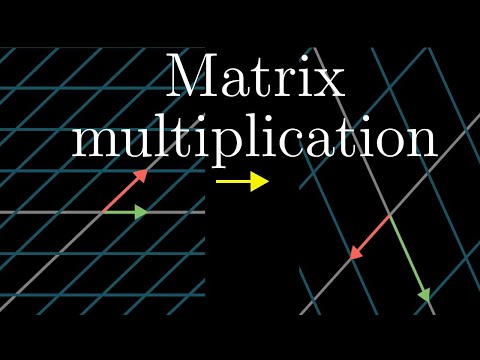
This video explains matrix multiplication as the composition of linear transformations. When you multiply matrices, you're essentially combining the effects of applying one transformation after another, which is visualized by tracking where basis vectors land.
Questions & Answers
What is matrix multiplication in terms of linear transformations?
Matrix multiplication represents the composition of linear transformations, where applying one transformation after another results in a new, single linear transformation.
How does matrix multiplication relate to applying transformations sequentially?
Multiplying matrices corresponds to applying the transformations they represent in sequence. The order matters: applying transformation B then A is represented by the matrix product BA.
Why is the order of matrix multiplication important?
The order matters because applying transformations in different sequences results in different overall transformations. For example, a shear then a rotation is not the same as a rotation then a shear.
What does it mean for matrix multiplication to be associative?
Associativity means that when multiplying three matrices (A, B, C), the grouping doesn't matter: (A * B) * C is the same as A * (B * C).
How does thinking about transformations simplify proving associativity?
If matrix multiplication represents sequential transformations, associativity (A * (B * C) = (A * B) * C) is trivial because it just means applying transformations C, then B, then A, regardless of grouping.
How is the composition matrix calculated from individual matrices?
The columns of the composition matrix are found by applying the first transformation (right matrix) to the basis vectors (columns of the right matrix) and then applying the second transformation (left matrix) to those results.
Key Terms
Linear Transformation — A function between vector spaces that preserves vector addition and scalar multiplication, visually represented as stretching, shearing, or rotating space while keeping grid lines parallel and evenly spaced.
Matrix Vector Multiplication — The computational process of applying a linear transformation (represented by a matrix) to a vector, resulting in a new vector.
Composition of Transformations — The combined effect of applying one linear transformation after another, which itself can be represented by a single linear transformation and its corresponding matrix.
Matrix Multiplication — The process of multiplying two matrices, which corresponds to the composition of the linear transformations they represent.