Full Transcript
https://www.youtube.com/watch?v=nh4q7mIhLrY
[00:00] in this video we're going to talk about
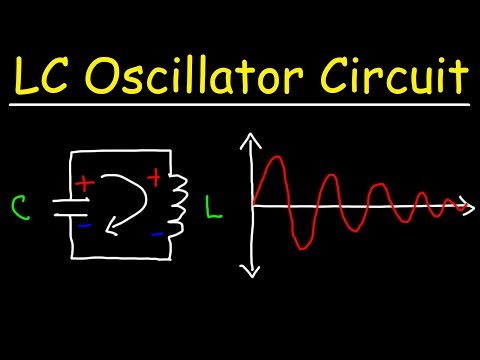
[00:02] in this video we're going to talk about the lc oscillator tank circuit
[00:05] the lc oscillator tank circuit so this circuit requires
[00:07] so this circuit requires two elements
[00:09] two elements a capacitor
[00:11] a capacitor and an inductor
[00:13] and an inductor both elements can store
[00:15] both elements can store and release
[00:17] and release energy
[00:18] energy so let's say that we charge up the
[00:20] so let's say that we charge up the capacitor
[00:21] capacitor initially before connecting it to the
[00:23] initially before connecting it to the inductor
[00:24] inductor so what's going to happen
[00:26] so what's going to happen current is going to flow from the
[00:28] current is going to flow from the capacitor to the inductor so right now
[00:31] capacitor to the inductor so right now the capacitor is discharging it's losing
[00:34] the capacitor is discharging it's losing energy
[00:35] energy the inductor
[00:37] the inductor is currently being charged by the
[00:38] is currently being charged by the capacitor
[00:41] as current flows in the inductor the
[00:44] as current flows in the inductor the inductor creates a magnetic field
[00:46] inductor creates a magnetic field the strength of the magnetic field is
[00:48] the strength of the magnetic field is dependent on the amount of current
[00:50] dependent on the amount of current flowing through the inductor
[00:53] flowing through the inductor so as the current increases
[00:55] so as the current increases the magnetic field
[00:56] the magnetic field created by the inductor expands
[00:59] created by the inductor expands so let's say this is a graph that
[01:02] so let's say this is a graph that represents the current with respect to time.
[01:06] so while the capacitor is discharging the current is increasing.
[01:13] now at some point it's going to reach a maximum.
[01:15] when that happens the inductor has absorbed the most energy it can from that particular circuit.
[01:22] in fact the energy stored in an inductor is equal to one-half times the inductance times the square of the current.
[01:30] so the maximum energy stored by the inductor is reach when the current flowing through the inductor is at its maximum.
[01:42] now during the second part of this lc circuit the current will decrease.
[01:49] when the current decreases the magnetic field inside the inductor begins to collapse it decreases.
[01:59] here's a formula that tells you the strength of the magnetic field along a
[02:03] strength of the magnetic field along a current carrying wire as you can see the
[02:05] current carrying wire as you can see the strength of the magnetic field is
[02:07] strength of the magnetic field is directly proportional to the current so
[02:09] directly proportional to the current so the current goes down
[02:11] the current goes down the magnetic field collapses
[02:13] the magnetic field collapses and at this point
[02:14] and at this point the inductor is releasing the stored
[02:17] the inductor is releasing the stored energy that it acquired from the
[02:19] energy that it acquired from the capacitor so it's putting that energy
[02:21] capacitor so it's putting that energy back into the circuit
[02:22] back into the circuit and i'm going to draw another picture
[02:24] and i'm going to draw another picture for
[02:26] for this situation
[02:28] this situation so when the magnetic field collapses
[02:30] so when the magnetic field collapses the polarity across the inductor will be
[02:32] the polarity across the inductor will be reversed
[02:35] so current is going to flow from the
[02:37] so current is going to flow from the positive terminal of the inductor
[02:39] positive terminal of the inductor towards the negative terminal
[02:41] towards the negative terminal so the inductor is releasing its stored
[02:43] so the inductor is releasing its stored energy
[02:45] energy as the inductor releases its stored
[02:47] as the inductor releases its stored energy the capacitor is absorbing that
[02:49] energy the capacitor is absorbing that energy so the capacitor is being charged
[02:52] energy so the capacitor is being charged at this point and any time the current
[02:54] at this point and any time the current decreases
[02:55] decreases the magnetic field collapses
[02:57] the magnetic field collapses and
[02:58] and it does so in such a way that the
[02:59] it does so in such a way that the inductor tries to maintain the decrease
[03:02] inductor tries to maintain the decrease in current and that's why the polarity
[03:04] in current and that's why the polarity reverses.
[03:06] now the next situation.
[03:09] now the next situation after the capacitor has been charged.
[03:13] it's going to discharge into the inductor right now.
[03:16] discharge into the inductor right now the polarity of the capacitor has been.
[03:17] the polarity of the capacitor has been reversed.
[03:19] reversed because current was flowing into this.
[03:21] because current was flowing into this terminal.
[03:24] now the polarity of the inductor is.
[03:25] now the polarity of the inductor is still the same.
[03:27] still the same but now that the capacitor has absorbed.
[03:29] but now that the capacitor has absorbed energy from the inductor it's going to.
[03:31] energy from the inductor it's going to release that energy back to the inductor.
[03:34] release that energy back to the inductor so current is going to flow from the.
[03:35] so current is going to flow from the positive terminal of the capacitor to.
[03:37] positive terminal of the capacitor to the negative terminal of the capacitor.
[03:39] the negative terminal of the capacitor and by the way this is.
[03:41] and by the way this is conventional current.
[03:43] conventional current not electron flow electron flows in the.
[03:45] not electron flow electron flows in the opposite direction so keep that in mind.
[03:48] opposite direction so keep that in mind so this is situation one number two.
[03:50] so this is situation one number two number three.
[03:51] number three so number three the current has reverse.
[03:53] so number three the current has reverse direction.
[03:55] direction so.
[03:56] so the graph is going to be below the the.
[03:58] the graph is going to be below the the x-axis.
[04:01] x-axis now once the current reaches its maximum.
[04:04] Now once the current reaches its maximum, all of the energy that has been stored in a capacitor has now been transferred back to the inductor.
[04:12] So now this is going to be step four.
[04:18] Because as step four begins, the current is going to decrease back to zero.
[04:23] Let's finish this.
[04:28] So now the current, as the current decreases, the magnetic field collapses.
[04:33] And the inductor is going to change polarity.
[04:38] So it's going to try to support the in current.
[04:43] And so the current is still flowing in the same direction.
[04:47] The only difference is now the inductor is releasing energy and the capacitor is absorbing energy.
[04:53] So this the inductor is discharging itself, but the capacitor is charging itself.
[04:58] And that's the basic idea behind how the LC oscillator circuit works.
[05:02] Energy is constantly being transferred.
[05:05] Energy is constantly being transferred back and forth from the capacitor to the inductor and vice versa.
[05:09] While one element is being charged, the other is being discharged.
[05:14] Now, you need to take into account friction.
[05:19] Because these oscillations do not continue forever without some energy source being applied to it.
[05:25] So initially, you'll have large oscillations when you place a fully charged capacitor across an inductor.
[05:33] But over time, these oscillations will lose amplitude.
[05:40] And the reason for that is as energy flows back and forth between the inductor and the capacitor, some of that energy is lost through the resistance of the circuit.
[05:49] It can be lost in the form of heat, and so the conductors, the wires, even the internal resistance of the inductor, all of that will dissipate energy.
[06:00] And so over time, the oscillations will average out to zero unless there's some feedback provided to it.
[06:06] Unless there's some feedback provided to the circuit.
[06:07] The circuit so if you can apply energy to this.
[06:09] So if you can apply energy to this oscillator.
[06:11] Oscillator periodically.
[06:14] The oscillations can be maintained.
[06:20] But you need to introduce some sort of.
[06:22] But you need to introduce some sort of feedback in order for the oscillations.
[06:24] Feedback in order for the oscillations to continue.
[06:25] To continue but that's the basic idea behind the LC.
[06:28] But that's the basic idea behind the LC oscillator tank circuit.
[06:29] Oscillator tank circuit so now you have a basic understanding of.
[06:32] So now you have a basic understanding of how it works.
[06:33] How it works so that's it for this video thanks for.
[06:35] So that's it for this video thanks for watching.