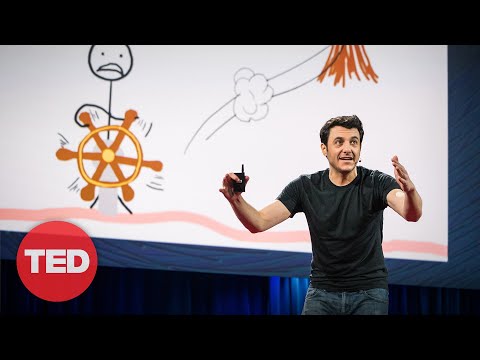
Inside the Mind of a Master Procrastinator | Tim Urban | TED
https://www.youtube.com/watch?v=arj7oStGLkU
[00:12] So in college, I was a government major, which means I had to write a lot of papers.
[00:19] Now, when a normal student writes a paper, they might spread the work out a little like this.
[00:23] So, you know --
[00:26] you get started maybe a little slowly, but you get enough done in the first week that, with some heavier days later on, everything gets done, things stay civil.
[00:35] And I would want to do that like that.
[00:38] That would be the plan.
[00:39] I would have it all ready to go, but then, actually, the paper would come along, and then I would kind of do this.
[00:48] And that would happen every single paper.
[00:51] But then came my 90-page senior thesis, a paper you're supposed to spend a year on.
[00:57] And I knew for a paper like that, my normal work flow was not an option.
[01:01] It was way too big a project.
[01:02] So I planned things out, and I decided I kind of had to go something like this.
[01:07] This is how the year would go.
[01:09] So I'd start off light, and I'd bump it up in the middle months,
[01:13] and then at the end, I would kick it up into high gear
[01:16] just like a little staircase.
[01:17] How hard could it be to walk up the stairs?
[01:20] No big deal, right?
[01:23] But then, the funniest thing happened.
[01:24] Those first few months?
[01:26] They came and went,
[01:28] and I couldn't quite do stuff.
[01:29] So we had an awesome new revised plan.
[01:32] And then --
[01:35] But then those middle months actually went by,
[01:38] and I didn't really write words,
[01:40] and so we were here.
[01:43] And then two months turned into one month,
[01:46] which turned into two weeks.
[01:47] And one day I woke up
[01:49] with three days until the deadline,
[01:53] still not having written a word,
[01:55] and so I did the only thing I could:
[01:57] I wrote 90 pages over 72 hours,
[02:00] pulling not one but two all-nighters --
[02:02] humans are not supposed to pull two all-nighters --
[02:06] sprinted across campus,
[02:08] dove in slow motion,
[02:09] and got it in just at the deadline.
[02:12] I thought that was the end of everything.
[02:14] But a week later I get a call,
[02:15] and it's the school.
[02:17] And they say, "Is this Tim Urban?"
[02:19] And I say, "Yeah."
[02:20] And they say, "We need to talk about your thesis."
[02:23] And I say, "OK."
[02:25] And they say,
[02:27] "It's the best one we've ever seen."
[02:36] That did not happen.
[02:40] It was a very, very bad thesis.
[02:45] I just wanted to enjoy that one moment when all of you thought,
[02:49] "This guy is amazing!"
[02:52] No, no, it was very, very bad.
[02:55] Anyway, today I'm a writer-blogger guy.
[02:58] I write the blog Wait But Why.
[03:00] And a couple of years ago, I decided to write about procrastination.
[03:04] My behavior has always perplexed the non-procrastinators around me,
[03:07] and I wanted to explain to the non-procrastinators of the world
[03:11] what goes on in the heads of procrastinators,
[03:13] and why we are the way we are.
[03:14] Now, I had a hypothesis that the brains of procrastinators were actually different than the brains of other people.
[03:21] And to test this, I found an MRI lab that actually let me scan both my brain and the brain of a proven non-procrastinator, so I could compare them.
[03:30] I actually brought them here to show you today.
[03:32] I want you to take a look carefully to see if you can notice a difference.
[03:36] I know that if you're not a trained brain expert, it's not that obvious, but just take a look, OK?
[03:40] So here's the brain of a non-procrastinator.
[03:48] Now... here's my brain.
[03:55] There is a difference.
[03:57] Both brains have a Rational Decision-Maker in them, but the procrastinator's brain also has an Instant Gratification Monkey.
[04:05] Now, what does this mean for the procrastinator?
[04:07] Well, it means everything's fine until this happens.
[04:09] [This is a perfect time to get some work done.] [Nope!]
[04:12] So the Rational Decision-Maker will make the rational decision
[04:15] to do something productive,
[04:17] but the Monkey doesn't like that plan,
[04:19] so he actually takes the wheel,
[04:20] and he says, "Actually, let's read the entire Wikipedia page
[04:23] of the Nancy Kerrigan/ Tonya Harding scandal,
[04:25] because I just remembered that that happened.
[04:29] Then --
[04:31] Then we're going to go over to the fridge,
[04:33] to see if there's anything new in there since 10 minutes ago.
[04:36] After that, we're going to go on a YouTube spiral
[04:39] that starts with videos of Richard Feynman talking about magnets
[04:42] and ends much, much later with us watching interviews
[04:45] with Justin Bieber's mom.
[04:49] "All of that's going to take a while,
[04:51] so we're not going to really have room on the schedule for any work today.
[04:54] Sorry!"
[04:58] Now, what is going on here?
[05:03] The Instant Gratification Monkey does not seem like a guy
[05:06] you want behind the wheel.
[05:07] He lives entirely in the present moment.
[05:09] He has no memory of the past, no knowledge of the future,
[05:12] and he only cares about two things:
[05:14] easy and fun.
[05:16] Now, in the animal world, that works fine.
[05:19] If you're a dog and you spend your whole life doing nothing other than easy and fun things, you're a huge success!
[05:25] (Laughter)
[05:27] And to the Monkey, humans are just another animal species.
[05:32] You have to keep well-slept, well-fed and propagating into the next generation, which in tribal times might have worked OK.
[05:38] But, if you haven't noticed, now we're not in tribal times.
[05:41] We're in an advanced civilization, and the Monkey does not know what that is.
[05:46] Which is why we have another guy in our brain, the Rational Decision-Maker, who gives us the ability to do things no other animal can do.
[05:53] We can visualize the future.
[05:55] We can see the big picture.
[05:57] We can make long-term plans.
[05:58] And he wants to take all of that into account.
[06:02] And he wants to just have us do whatever makes sense to be doing right now.
[06:06] Now, sometimes it makes sense to be doing things that are easy and fun, like when you're having dinner or going to bed or enjoying well-earned leisure time.
[06:14] That's why there's an overlap.
[06:15] Sometimes they agree.
[06:17] But other times, it makes much more sense to be doing things that are harder and less pleasant, for the sake of the big picture.
[06:25] And that's when we have a conflict.
[06:28] And for the procrastinator, that conflict tends to end a certain way every time, leaving him spending a lot of time in this orange zone, an easy and fun place that's entirely out of the Makes Sense circle.
[06:40] I call it the Dark Playground.
[06:42] (Laughter)
[06:43] Now, the Dark Playground is a place that all of you procrastinators out there know very well.
[06:50] It's where leisure activities happen at times when leisure activities are not supposed to be happening.
[06:56] The fun you have in the Dark Playground isn't actually fun, because it's completely unearned, and the air is filled with guilt, dread, anxiety, self-hatred -- all of those good procrastinator feelings.
[07:06] And the question is, in this situation, with the Monkey behind the wheel, how does the procrastinator ever get himself over here to this blue zone, a less pleasant place, but where really important things happen?
[07:17] Well, turns out the procrastinator has a guardian angel,
[07:22] Someone who's always looking down on him and watching over him in his darkest moments -- someone called the Panic Monster.
[07:34] Now, the Panic Monster is dormant most of the time, but he suddenly wakes up anytime a deadline gets too close or there's danger of public embarrassment, a career disaster or some other scary consequence.
[07:47] And importantly, he's the only thing the Monkey is terrified of.
[07:52] Now, he became very relevant in my life pretty recently, because the people of TED reached out to me about six months ago and invited me to do a TED Talk.
[08:07] Now, of course, I said yes.
[08:09] It's always been a dream of mine to have done a TED Talk in the past.
[08:24] But in the middle of all this excitement, the Rational Decision-Maker seemed to have something else on his mind.
[08:29] He was saying, "Are we clear on what we just accepted?
[08:32] Do we get what's going to be now happening one day in the future?
[08:35] We need to sit down and work on this right now."
[08:37] And the Monkey said, "Totally agree, but let's just open Google Earth and zoom in to the bottom of India, like 200 feet above the ground, and scroll up for two and a half hours til we get to the top of the country, so we can get a better feel for India."
[08:49] (Laughter)
[08:55] So that's what we did that day.
[08:56] (Laughter)
[09:00] As six months turned into four and then two and then one, the people of TED decided to release the speakers.
[09:07] And I opened up the website, and there was my face staring right back at me.
[09:11] And guess who woke up?
[09:13] (Laughter)
[09:17] So the Panic Monster starts losing his mind, and a few seconds later, the whole system's in mayhem.
[09:22] (Laughter)
[09:27] And the Monkey -- remember, he's terrified of the Panic Monster -- boom, he's up the tree!
[09:31] And finally, finally, the Rational Decision-Maker can take the wheel and I can start working on the talk.
[09:37] Now, the Panic Monster explains all kinds of pretty insane procrastinator behavior,
[09:43] like how someone like me could spend two weeks unable to start the opening sentence of a paper, and then miraculously find the unbelievable work ethic to stay up all night and write eight pages.
[09:56] And this entire situation, with the three characters -- this is the procrastinator's system.
[10:02] It's not pretty, but in the end, it works.
[10:05] This is what I decided to write about on the blog a couple of years ago.
[10:09] When I did, I was amazed by the response.
[10:12] Literally thousands of emails came in, from all different kinds of people from all over the world, doing all different kinds of things.
[10:19] These are people who were nurses, bankers, painters, engineers and lots and lots of PhD students.
[10:26] And they were all writing, saying the same thing:
[10:29] I have this problem too.
[10:31] But what struck me was the contrast between the light tone of the post and the heaviness of these emails.
[10:37] These people were writing with intense frustration about what procrastination had done to their lives, about what this Monkey had done to them.
[10:46] And I thought about this, and I said, well, if the procrastinator's system works, then what's going on?
[10:53] Why are all of these people in such a dark place?
[10:55] Well, it turns out that there's two kinds of procrastination.
[11:00] Everything I've talked about today, the examples I've given, they all have deadlines.
[11:04] And when there's deadlines, the effects of procrastination are contained to the short term because the Panic Monster gets involved.
[11:10] But there's a second kind of procrastination that happens in situations when there is no deadline.
[11:14] So if you wanted a career where you're a self-starter -- something in the arts, something entrepreneurial -- there's no deadlines on those things at first, because nothing's happening, not until you've gone out and done the hard work to get momentum, get things going.
[11:27] There's also all kinds of important things outside of your career
[11:30] that don't involve any deadlines, like seeing your family or exercising and taking care of your health, working on your relationship or getting out of a relationship that isn't working.
[11:39] Now if the procrastinator's only mechanism of doing these hard things is the Panic Monster, that's a problem, because in all of these non-deadline situations, the Panic Monster doesn't show up.
[11:51] He has nothing to wake up for, so the effects of procrastination, they're not contained; they just extend outward forever.
[11:58] And it's this long-term kind of procrastination that's much less visible and much less talked about than the funnier, short-term deadline-based kind.
[12:06] It's usually suffered quietly and privately.
[12:10] And it can be the source of a huge amount of long-term unhappiness, and regrets.
[12:16] And I thought, that's why those people are emailing, and that's why they're in such a bad place.
[12:22] It's not that they're cramming for some project.
[12:24] It's that long-term procrastination has made them feel like a spectator, at times, in their own lives.
[12:30] The frustration is not that they couldn't achieve their dreams; it's that they weren't even able to start chasing them.
[12:36] So I read these emails and I had a little bit of an epiphany -- that I don't think non-procrastinators exist.
[12:46] That's right -- I think all of you are procrastinators.
[12:49] Now, you might not all be a mess, like some of us, (Laughter) and some of you may have a healthy relationship with deadlines, but remember: the Monkey's sneakiest trick is when the deadlines aren't there.
[13:03] Now, I want to show you one last thing.
[13:05] I call this a Life Calendar.
[13:08] That's one box for every week of a 90-year life.
[13:13] That's not that many boxes, especially since we've already used a bunch of those.
[13:18] So I think we need to all take a long, hard look at that calendar.
[13:25] We need to think about what we're really procrastinating on, because everyone is procrastinating on something in life.
[13:32] We need to stay aware of the Instant Gratification Monkey.
[13:37] That's a job for all of us.
[13:40] And because there's not that many boxes on there,
[13:43] it's a job that should probably start today.
[13:45] Well, maybe not today, but ...
[13:50] You know.
[13:51] Sometime soon.
[13:53] Thank you.
Inside the Mind of a Master Procrastinator | Tim Urban | TED
https://www.youtube.com/watch?v=arj7oStGLkU
Translation: ja
[00:12] So in college, I was a government major, which means I had to write a lot of papers.
Üniversitedeyken işletme bölümü öğrencisiydim, bu da çok fazla makale yazmam gerektiği anlamına geliyordu.
[00:19] Now, when a normal student writes a paper, they might spread the work out a little like this.
Şimdi, normal bir öğrenci makale yazdığında, işi biraz şöyle yayabilir.
[00:23] So, you know --
Yani, bilirsiniz --
[00:26] you get started maybe a little slowly, but you get enough done in the first week that, with some heavier days later on, everything gets done, things stay civil.
belki biraz yavaş başlarsınız, ama ilk haftada o kadar çok iş yaparsınız ki, daha sonraki bazı yoğun günlerle, her şey biter, işler yolunda gider.
[00:35] And I would want to do that like that.
Ve bunu böyle yapmak isterdim.
[00:38] That would be the plan.
Plan bu olurdu.
[00:39] I would have it all ready to go, but then, actually, the paper would come along, and then I would kind of do this.
Her şeyi hazır tutardım, ama sonra, aslında, makale gelirdi ve ben de bunu yapardım.
[00:48] And that would happen every single paper.
Ve bu her makalede olurdu.
[00:51] But then came my 90-page senior thesis, a paper you're supposed to spend a year on.
Ama sonra, üzerinde bir yıl harcamanız gereken bir makale olan 90 sayfalık tezim geldi.
[00:57] And I knew for a paper like that, my normal work flow was not an option.
Ve böyle bir makale için normal iş akışımın bir seçenek olmadığını biliyordum.
[01:01] It was way too big a project.
Çok büyük bir projeydi.
[01:02] So I planned things out, and I decided I kind of had to go something like this.
Yani planlar yaptım ve şöyle bir yol izlemem gerektiğini düşündüm.
[01:07] This is how the year would go.
Yıl böyle geçerdi.
[01:09] So I'd start off light, and I'd bump it up in the middle months,
Yani hafif başlardım ve orta aylarda yoğunluğu artırırdım,
[01:13] and then at the end, I would kick it up into high gear
そして最後に、ギアをトップに入れていました
[01:16] just like a little staircase.
まるで小さな階段のように。
[01:17] How hard could it be to walk up the stairs?
階段を上るのはそんなに大変なことだろうか?
[01:20] No big deal, right?
大したことない、だろ?
[01:23] But then, the funniest thing happened.
しかし、その後、最も面白いことが起こりました。
[01:24] Those first few months?
最初の数ヶ月は?
[01:26] They came and went,
あっという間に過ぎ去り、
[01:28] and I couldn't quite do stuff.
私はあまり何もできませんでした。
[01:29] So we had an awesome new revised plan.
そこで、素晴らしい新しい改訂計画を立てました。
[01:32] And then --
そしてその後--
[01:35] But then those middle months actually went by,
しかし、その中間の数ヶ月は実際に過ぎ去り、
[01:38] and I didn't really write words,
私は実際には何も書いておらず、
[01:40] and so we were here.
それで私たちはここにいました。
[01:43] And then two months turned into one month,
そして2ヶ月が1ヶ月になり、
[01:46] which turned into two weeks.
それが2週間に変わりました。
[01:47] And one day I woke up
そしてある日、私は目を覚ますと
[01:49] with three days until the deadline,
締め切りまであと3日でしたが、
[01:53] still not having written a word,
まだ何も書いていませんでした。
[01:55] and so I did the only thing I could:
そこで私はできる唯一のことだけをしました。
[01:57] I wrote 90 pages over 72 hours,
私は72時間で90ページを書き上げました。
[02:00] pulling not one but two all-nighters --
徹夜を1回ではなく2回しました--
[02:02] humans are not supposed to pull two all-nighters --
人間は徹夜を2回するべきではありません--
[02:06] sprinted across campus,
キャンパスを駆け抜け、
[02:08] dove in slow motion,
スローモーションで飛び込み、
[02:09] and got it in just at the deadline.
締め切りぎりぎりで提出しました。
[02:12] I thought that was the end of everything.
それがすべてが終わったと思いました。
[02:14] But a week later I get a call,
Ama bir hafta sonra bir telefon alıyorum,
[02:15] and it's the school.
ve okuldan.
[02:17] And they say, "Is this Tim Urban?"
Ve diyorlar ki, "Tim Urban mısınız?"
[02:19] And I say, "Yeah."
Ve ben de, "Evet."
[02:20] And they say, "We need to talk about your thesis."
Ve diyorlar ki, "Teziniz hakkında konuşmamız gerekiyor."
[02:23] And I say, "OK."
Ve ben de, "Tamam."
[02:25] And they say,
Ve diyorlar ki,
[02:27] "It's the best one we've ever seen."
"Şimdiye kadar gördüğümüz en iyisi."
[02:36] That did not happen.
Bu olmadı.
[02:40] It was a very, very bad thesis.
Çok, çok kötü bir tezdi.
[02:45] I just wanted to enjoy that one moment when all of you thought,
Sadece hepinizin düşündüğü o anın tadını çıkarmak istedim,
[02:49] "This guy is amazing!"
"Bu adam harika!"
[02:52] No, no, it was very, very bad.
Hayır, hayır, çok, çok kötüydü.
[02:55] Anyway, today I'm a writer-blogger guy.
Her neyse, bugün ben bir yazar-blogger adamım.
[02:58] I write the blog Wait But Why.
Wait But Why blogunu yazıyorum.
[03:00] And a couple of years ago, I decided to write about procrastination.
Ve birkaç yıl önce erteleme hakkında yazmaya karar verdim.
[03:04] My behavior has always perplexed the non-procrastinators around me,
Davranışım etrafımdaki ertelemeyenleri her zaman şaşırttı,
[03:07] and I wanted to explain to the non-procrastinators of the world
ve dünyanın ertelemeyenlerine açıklamak istedim
[03:11] what goes on in the heads of procrastinators,
erteleyicilerin kafasında neler olduğunu,
[03:13] and why we are the way we are.
ve neden böyle olduğumuzu.
[03:14] Now, I had a hypothesis that the brains of procrastinators were actually different than the brains of other people.
Şimdi, erteleyicilerin beyinlerinin aslında diğer insanların beyinlerinden farklı olduğu hipotezine sahiptim.
[03:21] And to test this, I found an MRI lab that actually let me scan both my brain and the brain of a proven non-procrastinator, so I could compare them.
Ve bunu test etmek için, hem kendi beynimi hem de kanıtlanmış bir ertelemeyici olmayan kişinin beynini taramama izin veren bir MRI laboratuvarı buldum, böylece onları karşılaştırabilirdim.
[03:30] I actually brought them here to show you today.
Aslında onları bugün size göstermek için buraya getirdim.
[03:32] I want you to take a look carefully to see if you can notice a difference.
Farkı fark edip edemeyeceğinizi görmek için dikkatlice bakmanızı istiyorum.
[03:36] I know that if you're not a trained brain expert, it's not that obvious, but just take a look, OK?
Eğitimli bir beyin uzmanı değilseniz, bunun o kadar da belirgin olmadığını biliyorum, ama sadece bir bakın, tamam mı?
[03:40] So here's the brain of a non-procrastinator.
İşte ertelemeyici olmayan birinin beyni.
[03:48] Now... here's my brain.
Şimdi... işte benim beynim.
[03:55] There is a difference.
Bir fark var.
[03:57] Both brains have a Rational Decision-Maker in them, but the procrastinator's brain also has an Instant Gratification Monkey.
Her iki beyinde de bir Akılcı Karar Verici bulunur, ancak erteleyicinin beyninde ayrıca bir Anlık Tatmin Maymunu da bulunur.
[04:05] Now, what does this mean for the procrastinator?
Peki, bu erteleyici için ne anlama geliyor?
[04:07] Well, it means everything's fine until this happens.
Pekala, bu olana kadar her şey yolunda demektir.
[04:09] [This is a perfect time to get some work done.] [Nope!]
[Bu, biraz iş yapmak için mükemmel bir zaman.] [Hayır!]
[04:12] So the Rational Decision-Maker will make the rational decision
Yani Akılcı Karar Verici rasyonel kararı verecektir
[04:15] to do something productive,
생산적인 일을 하기 위해,
[04:17] but the Monkey doesn't like that plan,
하지만 원숭이는 그 계획을 좋아하지 않습니다.
[04:19] so he actually takes the wheel,
그래서 그는 실제로 운전대를 잡습니다.
[04:20] and he says, "Actually, let's read the entire Wikipedia page
그리고 그는 말합니다. "사실, 위키피디아 전체 페이지를 읽어봅시다.
[04:23] of the Nancy Kerrigan/ Tonya Harding scandal,
낸시 케리건/토냐 하딩 스캔들에 대한 것입니다.
[04:25] because I just remembered that that happened.
그것이 일어났던 것을 방금 기억했기 때문입니다.
[04:29] Then --
그러면 --
[04:31] Then we're going to go over to the fridge,
그러면 냉장고로 갈 것입니다.
[04:33] to see if there's anything new in there since 10 minutes ago.
10분 전 이후로 안에 새로운 것이 있는지 확인하기 위해서입니다.
[04:36] After that, we're going to go on a YouTube spiral
그 후, 우리는 유튜브 나선형에 빠질 것입니다.
[04:39] that starts with videos of Richard Feynman talking about magnets
리처드 파인만이 자석에 대해 이야기하는 비디오로 시작하여
[04:42] and ends much, much later with us watching interviews
훨씬 나중에 저스틴 비버 엄마와의 인터뷰를 보면서 끝납니다.
[04:45] with Justin Bieber's mom.
저스틴 비버 엄마와의 인터뷰를 보면서 끝납니다.
[04:49] "All of that's going to take a while,
"그 모든 것을 하는 데 시간이 좀 걸릴 것입니다.
[04:51] so we're not going to really have room on the schedule for any work today.
그래서 오늘 일정에 일할 공간이 거의 없을 것입니다.
[04:54] Sorry!"
죄송합니다!"
[04:58] Now, what is going on here?
자, 여기서 무슨 일이 일어나고 있는 걸까요?
[05:03] The Instant Gratification Monkey does not seem like a guy
즉각적인 만족 원숭이는 그런 사람처럼 보이지 않습니다.
[05:06] you want behind the wheel.
당신이 운전대를 잡기를 원하는 사람.
[05:07] He lives entirely in the present moment.
그는 전적으로 현재 순간에 삽니다.
[05:09] He has no memory of the past, no knowledge of the future,
그는 과거의 기억도, 미래의 지식도 없습니다.
[05:12] and he only cares about two things:
그리고 그는 단 두 가지에만 신경 씁니다.
[05:14] easy and fun.
쉽고 재미있는 것.
[05:16] Now, in the animal world, that works fine.
Şimdi, hayvanlar aleminde bu işe yarar.
[05:19] If you're a dog and you spend your whole life doing nothing other than easy and fun things, you're a huge success!
Eğer bir köpekseniz ve tüm hayatınızı kolay ve eğlenceli şeylerden başka bir şey yapmadan geçiriyorsanız, büyük bir başarı elde etmişsiniz demektir!
[05:25] (Laughter)
(Gülüşmeler)
[05:27] And to the Monkey, humans are just another animal species.
Ve Maymun'a göre, insanlar sadece başka bir hayvan türüdür.
[05:32] You have to keep well-slept, well-fed and propagating into the next generation, which in tribal times might have worked OK.
İyi uyumuş, iyi beslenmiş ve bir sonraki nesle üreyen biri olmalısınız, ki bu kabile zamanlarında işe yaramış olabilir.
[05:38] But, if you haven't noticed, now we're not in tribal times.
Ama fark etmediyseniz, artık kabile zamanlarında değiliz.
[05:41] We're in an advanced civilization, and the Monkey does not know what that is.
Gelişmiş bir medeniyetteyiz ve Maymun bunun ne olduğunu bilmiyor.
[05:46] Which is why we have another guy in our brain, the Rational Decision-Maker, who gives us the ability to do things no other animal can do.
Bu yüzden beynimizde başka bir karakter var, Akılcı Karar Verici, bize başka hiçbir hayvanın yapamayacağı şeyleri yapma yeteneği veriyor.
[05:53] We can visualize the future.
Geleceği görselleştirebiliriz.
[05:55] We can see the big picture.
Büyük resmi görebiliriz.
[05:57] We can make long-term plans.
Uzun vadeli planlar yapabiliriz.
[05:58] And he wants to take all of that into account.
Ve tüm bunları hesaba katmak istiyor.
[06:02] And he wants to just have us do whatever makes sense to be doing right now.
Ve sadece şu anda yapmanın mantıklı olduğu her şeyi yapmamızı istiyor.
[06:06] Now, sometimes it makes sense to be doing things that are easy and fun, like when you're having dinner or going to bed or enjoying well-earned leisure time.
Şimdi, bazen kolay ve eğlenceli şeyler yapmak mantıklıdır, örneğin akşam yemeği yerken, yatarken veya hak edilmiş boş zamanın tadını çıkarırken.
[06:14] That's why there's an overlap.
Bu yüzden bir örtüşme var.
[06:15] Sometimes they agree.
Bazen aynı fikirde olurlar.
[06:17] But other times, it makes much more sense to be doing things that are harder and less pleasant, for the sake of the big picture.
Ancak bazen, büyük resmi düşünerek daha zor ve daha az keyifli şeyler yapmak daha mantıklıdır.
[06:25] And that's when we have a conflict.
Ve işte o zaman bir çatışma yaşarız.
[06:28] And for the procrastinator, that conflict tends to end a certain way every time, leaving him spending a lot of time in this orange zone, an easy and fun place that's entirely out of the Makes Sense circle.
Ve erteleyici için bu çatışma her zaman belirli bir şekilde sona erme eğilimindedir, onu bu turuncu bölgede, Mantıklı Daire'nin tamamen dışında kalan kolay ve eğlenceli bir yerde çok zaman harcarken bırakır.
[06:40] I call it the Dark Playground.
Ben oraya Karanlık Oyun Alanı diyorum.
[06:42] (Laughter)
(Kıkırdama)
[06:43] Now, the Dark Playground is a place that all of you procrastinators out there know very well.
Şimdi, Karanlık Oyun Alanı, orada bulunan siz erteleyicilerin hepsinin çok iyi bildiği bir yerdir.
[06:50] It's where leisure activities happen at times when leisure activities are not supposed to be happening.
Eğlence aktivitelerinin olması gerekmediği zamanlarda eğlence aktivitelerinin gerçekleştiği yerdir.
[06:56] The fun you have in the Dark Playground isn't actually fun, because it's completely unearned, and the air is filled with guilt, dread, anxiety, self-hatred -- all of those good procrastinator feelings.
Karanlık Oyun Alanı'nda yaşadığınız eğlence aslında eğlence değildir, çünkü tamamen hak edilmemiştir ve hava suçluluk, dehşet, endişe, nefretiyle doludur - tüm o iyi erteleyici hisleri.
[07:06] And the question is, in this situation, with the Monkey behind the wheel, how does the procrastinator ever get himself over here to this blue zone, a less pleasant place, but where really important things happen?
Ve soru şu ki, bu durumda, direksiyonda Maymun varken, erteleyici kendini buraya, daha az hoş bir yer olan ama gerçekten önemli şeylerin olduğu bu mavi bölgeye nasıl getirir?
[07:17] Well, turns out the procrastinator has a guardian angel,
Pekala, anlaşılan erteleyicinin bir koruyucu meleği var,
[07:22] Someone who's always looking down on him and watching over him in his darkest moments -- someone called the Panic Monster.
En karanlık anlarında onu sürekli aşağılayan ve gözeten biri -- Panik Canavarı denen biri.
[07:34] Now, the Panic Monster is dormant most of the time, but he suddenly wakes up anytime a deadline gets too close or there's danger of public embarrassment, a career disaster or some other scary consequence.
Şimdi, Panik Canavarı çoğu zaman uykudadır, ancak bir son teslim tarihi çok yaklaştığında veya halka açık bir utanç, kariyer felaketi veya başka bir korkunç sonuç tehlikesi olduğunda aniden uyanır.
[07:47] And importantly, he's the only thing the Monkey is terrified of.
Ve daha da önemlisi, Maymun'un korktuğu tek şey odur.
[07:52] Now, he became very relevant in my life pretty recently, because the people of TED reached out to me about six months ago and invited me to do a TED Talk.
Şimdi, hayatımda oldukça yakın zamanda çok alakalı hale geldi, çünkü TED halkı bana yaklaşık altı ay önce ulaştı ve beni bir TED Konuşması yapmaya davet etti.
[08:07] Now, of course, I said yes.
Elbette evet dedim.
[08:09] It's always been a dream of mine to have done a TED Talk in the past.
Geçmişte bir TED konuşması yapmış olmak her zaman benim hayalim olmuştur.
[08:24] But in the middle of all this excitement, the Rational Decision-Maker seemed to have something else on his mind.
Ancak tüm bu heyecanın ortasında, Akılcı Karar Verici'nin aklında başka bir şey varmış gibi görünüyordu.
[08:29] He was saying, "Are we clear on what we just accepted?
Şunu söylüyordu: "Az önce kabul ettiğimiz şeyi netleştirdik mi?
[08:32] Do we get what's going to be now happening one day in the future?
Gelecekte bir gün olacakları anlıyor muyuz?
[08:35] We need to sit down and work on this right now."
Hemen oturup bunun üzerinde çalışmamız gerekiyor."
[08:37] And the Monkey said, "Totally agree, but let's just open Google Earth and zoom in to the bottom of India, like 200 feet above the ground, and scroll up for two and a half hours til we get to the top of the country, so we can get a better feel for India."
Ve Maymun dedi ki: "Kesinlikle katılıyorum, ama hadi Google Earth'ü açıp Hindistan'ın dibine, yerden yaklaşık 200 fit yukarıya yakınlaştırıp, ülkenin tepesine ulaşana kadar iki buçuk saat yukarı kaydıralım, böylece Hindistan'ı daha iyi hissedebiliriz."
[08:49] (Laughter)
(Gülüşmeler)
[08:55] So that's what we did that day.
İşte o gün bunu yaptık.
[08:56] (Laughter)
(Gülüşmeler)
[09:00] As six months turned into four and then two and then one, the people of TED decided to release the speakers.
Altı ay dörde, sonra ikiye ve sonra bire dönüştükçe, TED halkı konuşmacıları serbest bırakmaya karar verdi.
[09:07] And I opened up the website, and there was my face staring right back at me.
Ve web sitesini açtım, ve yüzüm bana bakıyordu.
[09:11] And guess who woke up?
Ve kimin uyandığını tahmin edin?
[09:13] (Laughter)
(Gülüşmeler)
[09:17] So the Panic Monster starts losing his mind, and a few seconds later, the whole system's in mayhem.
Böylece Panik Canavarı aklını kaybetmeye başlar ve birkaç saniye sonra tüm sistem kaos içinde kalır.
[09:22] (Laughter)
(Gülüşmeler)
[09:27] And the Monkey -- remember, he's terrified of the Panic Monster -- boom, he's up the tree!
そしてサルは――パニックモンスターが怖いことを思い出してください――ドカンと木の上に登りました!
[09:31] And finally, finally, the Rational Decision-Maker can take the wheel and I can start working on the talk.
そしてついに、ついに、合理的な意思決定者がハンドルを握り、講演の準備を始めることができます。
[09:37] Now, the Panic Monster explains all kinds of pretty insane procrastinator behavior,
さて、パニックモンスターは、かなり狂った先延ばし行動のあらゆる種類を説明します、
[09:43] like how someone like me could spend two weeks unable to start the opening sentence of a paper, and then miraculously find the unbelievable work ethic to stay up all night and write eight pages.
私のような人間が、論文の冒頭の一文を書き始めることができずに2週間を費やし、そして奇跡的に信じられないほどの労働倫理を見つけて一晩中起きて8ページを書くことができるようなものです。
[09:56] And this entire situation, with the three characters -- this is the procrastinator's system.
そして、この3人のキャラクターが登場するこの状況全体――これが先延ばし者のシステムです。
[10:02] It's not pretty, but in the end, it works.
見栄えは良くありませんが、結局はうまくいきます。
[10:05] This is what I decided to write about on the blog a couple of years ago.
これが数年前にブログで書くことに決めたことです。
[10:09] When I did, I was amazed by the response.
そうしたところ、その反響に驚きました。
[10:12] Literally thousands of emails came in, from all different kinds of people from all over the world, doing all different kinds of things.
文字通り何千通ものメールが届き、世界中のあらゆる種類の、あらゆる種類のことをしている人々からでした。
[10:19] These are people who were nurses, bankers, painters, engineers and lots and lots of PhD students.
看護師、銀行員、画家、エンジニア、そして多くの多くの博士課程の学生でした。
[10:26] And they were all writing, saying the same thing:
そして彼らは皆、同じことを書いていました:
[10:29] I have this problem too.
Benim de bu sorunum var.
[10:31] But what struck me was the contrast between the light tone of the post and the heaviness of these emails.
Ama beni şaşırtan, gönderinin hafif tonu ile bu e-postaların ağırlığı arasındaki kontrasttı.
[10:37] These people were writing with intense frustration about what procrastination had done to their lives, about what this Monkey had done to them.
Bu insanlar ertelemenin hayatlarına neler yaptığından, bu Maymun'un onlara neler yaptığından yoğun bir hayal kırıklığıyla yazıyorlardı.
[10:46] And I thought about this, and I said, well, if the procrastinator's system works, then what's going on?
Ve bunu düşündüm ve dedim ki, peki, erteleyicinin sistemi işe yarıyorsa, o zaman ne oluyor?
[10:53] Why are all of these people in such a dark place?
Neden bu insanların hepsi bu kadar karanlık bir yerde?
[10:55] Well, it turns out that there's two kinds of procrastination.
Peki, iki tür erteleme olduğu ortaya çıkıyor.
[11:00] Everything I've talked about today, the examples I've given, they all have deadlines.
Bugün bahsettiğim her şey, verdiğim örnekler, hepsinin son teslim tarihleri var.
[11:04] And when there's deadlines, the effects of procrastination are contained to the short term because the Panic Monster gets involved.
Ve son teslim tarihleri olduğunda, ertelemenin etkileri Panik Canavarı devreye girdiği için kısa vadede sınırlı kalır.
[11:10] But there's a second kind of procrastination that happens in situations when there is no deadline.
Ancak son teslim tarihinin olmadığı durumlarda ortaya çıkan ikinci bir erteleme türü vardır.
[11:14] So if you wanted a career where you're a self-starter -- something in the arts, something entrepreneurial -- there's no deadlines on those things at first, because nothing's happening, not until you've gone out and done the hard work to get momentum, get things going.
Yani kendi işini kuracağın bir kariyer istiyorsan - sanatta bir şeyler, girişimcilikte bir şeyler - başlangıçta bu şeyler için son teslim tarihleri yoktur, çünkü hiçbir şey olmuyordur, siz dışarı çıkıp ivme kazanmak, işleri başlatmak için zor işi yapana kadar.
[11:27] There's also all kinds of important things outside of your career
Kariyerinizin dışında her türlü önemli şey de vardır
[11:30] that don't involve any deadlines, like seeing your family or exercising and taking care of your health, working on your relationship or getting out of a relationship that isn't working.
hiçbir son teslim tarihi içermeyen, ailenizi görmek veya egzersiz yapmak ve sağlığınıza dikkat etmek, ilişkiniz üzerinde çalışmak veya işe yaramayan bir ilişkiden çıkmak gibi.
[11:39] Now if the procrastinator's only mechanism of doing these hard things is the Panic Monster, that's a problem, because in all of these non-deadline situations, the Panic Monster doesn't show up.
Şimdi eğer erteleyicinin bu zor şeyleri yapma konusundaki tek mekanizması Panik Canavarı ise, bu bir sorundur, çünkü bu son teslim tarihi olmayan durumlarda Panik Canavarı ortaya çıkmaz.
[11:51] He has nothing to wake up for, so the effects of procrastination, they're not contained; they just extend outward forever.
Uyanacak bir şeyi yok, bu yüzden ertelemenin etkileri kontrol altına alınamaz; sonsuza dek dışarı doğru uzanırlar.
[11:58] And it's this long-term kind of procrastination that's much less visible and much less talked about than the funnier, short-term deadline-based kind.
Ve bu, daha komik, kısa vadeli son teslim tarihine dayalı türden çok daha az görünür ve hakkında çok daha az konuşulan uzun vadeli erteleme türüdür.
[12:06] It's usually suffered quietly and privately.
Genellikle sessizce ve özel olarak çekilir.
[12:10] And it can be the source of a huge amount of long-term unhappiness, and regrets.
Ve büyük miktarda uzun vadeli mutsuzluğun ve pişmanlığın kaynağı olabilir.
[12:16] And I thought, that's why those people are emailing, and that's why they're in such a bad place.
Ve düşündüm ki, insanların e-posta göndermesinin ve bu kadar kötü durumda olmasının nedeni bu.
[12:22] It's not that they're cramming for some project.
Bir proje için son dakikada çalıştıkları değil.
[12:24] It's that long-term procrastination has made them feel like a spectator, at times, in their own lives.
Uzun vadeli ertelemenin, zaman zaman kendi hayatlarında bir seyirci gibi hissetmelerine neden olmasıdır.
[12:30] The frustration is not that they couldn't achieve their dreams; it's that they weren't even able to start chasing them.
Hayal kırıklığı, hayallerini gerçekleştirememeleri değil; onlara ulaşmaya bile başlayamamış olmalarıdır.
[12:36] So I read these emails and I had a little bit of an epiphany -- that I don't think non-procrastinators exist.
Bu e-postaları okudum ve bir aydınlanma yaşadım -- ertelemeyenlerin var olmadığına inanıyorum.
[12:46] That's right -- I think all of you are procrastinators.
Bu doğru -- hepinizin erteleyici olduğunu düşünüyorum.
[12:49] Now, you might not all be a mess, like some of us, (Laughter) and some of you may have a healthy relationship with deadlines, but remember: the Monkey's sneakiest trick is when the deadlines aren't there.
Şimdi, hepiniz bizden bazıları gibi bir karmaşa olmayabilirsiniz, (Gülüşmeler) ve bazınızın teslim tarihlerle sağlıklı bir ilişkisi olabilir, ama unutmayın: Maymun'un en sinsi hilesi, teslim tarihlerinin olmadığı zamandır.
[13:03] Now, I want to show you one last thing.
Şimdi size son bir şey göstermek istiyorum.
[13:05] I call this a Life Calendar.
Buna Yaşam Takvimi diyorum.
[13:08] That's one box for every week of a 90-year life.
Bu, 90 yıllık bir yaşamın her haftası için bir kutudur.
[13:13] That's not that many boxes, especially since we've already used a bunch of those.
Özellikle çoğunu zaten kullandığımız göz önüne alındığında, bu o kadar da çok kutu değil.
[13:18] So I think we need to all take a long, hard look at that calendar.
Bu yüzden sanırım hepimizin o takvime uzun ve dikkatli bir şekilde bakmamız gerekiyor.
[13:25] We need to think about what we're really procrastinating on, because everyone is procrastinating on something in life.
Gerçekten neyi ertelediğimizi düşünmemiz gerekiyor, çünkü herkes hayatta bir şeyi erteliyor.
[13:32] We need to stay aware of the Instant Gratification Monkey.
Anında Tatmin Maymunu'nun farkında olmalıyız.
[13:37] That's a job for all of us.
Bu hepimizin görevi.
[13:40] And because there's not that many boxes on there,
Ve orada çok fazla kutu olmadığı için,
[13:43] it's a job that should probably start today.
muhtemelen bugün başlaması gereken bir iş.
[13:45] Well, maybe not today, but ...
Pekala, belki bugün değil ama...
[13:50] You know.
Bilirsin.
[13:51] Sometime soon.
Yakında bir ara.
[13:53] Thank you.
Teşekkür ederim.