youtube-transcript.ai Extract yours →

How Great Leaders Inspire Action | Simon Sinek | TED

https://www.youtube.com/watch?v=qp0HIF3SfI4
Translation: zh-TW

[00:16] How do you explain when things don't go as we assume?
當事情不如我們預期時,你該如何解釋?

[00:20] Or better, how do you explain when others are able to achieve things that seem to defy all of the assumptions?
或者更進一步,當別人能夠達成那些看似違背所有假設的事情時,你又該如何解釋?

[00:27] For example:
舉例來說:

[00:29] Why is Apple so innovative?
為什麼蘋果如此創新?

[00:31] Year after year, after year, they're more innovative than all their competition.
年復一年,他們比所有競爭對手都更具創新力。

[00:36] And yet, they're just a computer company.
然而,他們只是一家電腦公司。

[00:38] They're just like everyone else.
他們和其他人一樣。

[00:40] They have the same access to the same talent, the same agencies, the same consultants, the same media.
他們擁有相同的資源,同樣的人才、同樣的機構、同樣的顧問、同樣的媒體。

[00:45] Then why is it that they seem to have something different?
那麼,為什麼他們似乎擁有些不同的東西?

[00:50] Why is it that Martin Luther King led the Civil Rights Movement?
為什麼是馬丁·路德·金領導了民權運動?

[00:54] He wasn't the only man who suffered in pre-civil rights America, and he certainly wasn't the only great orator of the day.
在民權運動之前的美國,遭受苦難的不只他一人,他也絕非當時唯一的偉大演說家。

[01:01] Why him?
為什麼是他?

[01:02] And why is it that the Wright brothers were able to figure out controlled, powered man flight when there were certainly other teams who were better qualified, better funded -- and they didn't achieve powered man flight,
又為什麼是萊特兄弟能夠掌握受控的動力載人飛行,儘管當時肯定有其他團隊更有資格、資金更充足——但他們卻未能實現動力載人飛行,

[01:16] And the Wright brothers beat them to it.
而莱特兄弟抢先一步做到了。

[01:18] There's something else at play here.
这里还有别的原因。

[01:21] About three and a half years ago, I made a discovery.
大约三年前半,我做了一个发现。

[01:25] And this discovery profoundly changed my view on how I thought the world worked,
这个发现深刻地改变了我对世界运作方式的看法,

[01:31] and it even profoundly changed the way in which I operate in it.
甚至深刻地改变了我运作的方式。

[01:37] As it turns out, there's a pattern.
结果发现,有一个模式。

[01:40] As it turns out, all the great inspiring leaders and organizations in the world,
结果发现,世界上所有伟大的、鼓舞人心的领导者和组织,

[01:44] whether it's Apple or Martin Luther King or the Wright brothers,
无论是苹果公司、马丁·路德·金还是莱特兄弟,

[01:47] they all think, act and communicate the exact same way.
他们思考、行动和沟通的方式都完全一样。

[01:51] And it's the complete opposite to everyone else.
这与其他人完全相反。

[01:55] All I did was codify it,
我所做的就是将其规范化,

[01:57] and it's probably the world's simplest idea.
这可能是世界上最简单的想法。

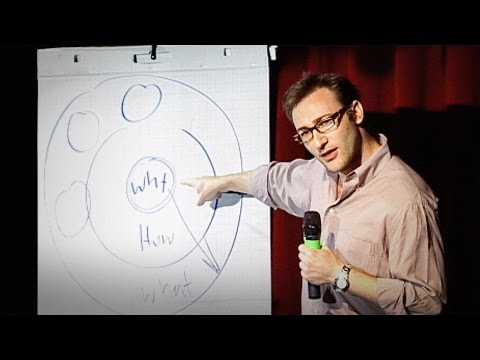
[02:01] I call it the golden circle.
我称之为黄金圈。

[02:11] Why? How? What?
为什么?怎么做?做什么?

[02:14] This little idea explains
这个小小的想法解释了

[02:16] Why some organizations and some leaders are able to inspire where others aren't.
為什麼有些組織和領導者能夠激勵他人,而有些則不能。

[02:20] Let me define the terms really quickly.
讓我快速定義一下這些術語。

[02:22] Every single person, every single organization on the planet knows what they do, 100 percent.
地球上的每一個人,每一個組織,百分之百地知道他們在做什麼。

[02:29] Some know how they do it, whether you call it your differentiated value proposition or your proprietary process or your USP.
有些人知道他們是怎麼做的,無論你稱之為差異化的價值主張、專有流程還是獨特賣點。

[02:36] But very, very few people or organizations know why they do what they do.
但很少很少有人或組織知道他們為什麼要做他們所做的事情。

[02:41] And by 'why' I don't mean 'to make a profit.'
我說的「為什麼」並不是指「為了賺錢」。

[02:43] That's a result. It's always a result.
那是結果。它總是結果。

[02:45] By 'why,' I mean: What's your purpose?
我說的「為什麼」,是指:你的目的是什麼?

[02:47] What's your cause? What's your belief?
你的使命是什麼?你的信念是什麼?

[02:49] Why does your organization exist?
你的組織為什麼存在?

[02:53] Why do you get out of bed in the morning?
你為什麼早上起床?

[02:55] And why should anyone care?
為什麼別人應該關心?

[02:58] As a result, the way we think, we act, the way we communicate is from the outside in, it's obvious.
結果是,我們的思維方式、行為方式、溝通方式都是由外而內,這是顯而易見的。

[03:03] We go from the clearest thing to the fuzziest thing.
我們從最清晰的事情轉向最模糊的事情。

[03:05] But the inspired leaders and the inspired organizations -- regardless of their size, regardless of their industry -- all think, act and communicate from the inside out.
但是,受啟發的領導者和受啟發的組織——無論其規模大小,無論其行業如何——都從內而外地思考、行動和溝通。

[03:17] Let me give you an example.
让我举个例子。

[03:19] I use Apple because they're easy to understand and everybody gets it.
我使用苹果,因为它们易于理解,而且每个人都明白。

[03:22] If Apple were like everyone else,
如果苹果像其他人一样,

[03:25] a marketing message from them might sound like this:
来自他们的营销信息可能会是这样的:

[03:28] We make great computers.
我们制造出色的电脑。

[03:31] They're beautifully designed, simple to use and user friendly.
它们设计精美,简单易用且用户友好。

[03:35] Want to buy one?
想买一个吗?

[03:37] Meh.
嗯。

[03:38] That's how most of us communicate.
我们大多数人都是这样沟通的。

[03:40] That's how most marketing and sales are done,
大多数营销和销售都是这样进行的,

[03:42] that's how we communicate interpersonally.
我们人际交往也是这样进行的。

[03:44] We say what we do,
我们说我们做什么,

[03:46] we say how we're different or better
我们说我们如何与众不同或更好

[03:48] and we expect some sort of a behavior,
然后我们期望某种行为,

[03:50] a purchase, a vote, something like that.
购买、投票,诸如此类。

[03:52] Here's our new law firm:
这是我们的新律师事务所:

[03:53] We have the best lawyers with the biggest clients,
我们拥有最好的律师和最大的客户,

[03:56] we always perform for our clients.
我们始终为客户表现出色。

[03:57] Here's our new car:
这是我们的新车:

[03:59] It gets great gas mileage, it has leather seats.
它燃油经济性好,有真皮座椅。

[04:01] Buy our car.
买我们的车。

[04:03] But it's uninspiring.
但它毫无吸引力。

[04:04] Here's how Apple actually communicates.
苹果的实际沟通方式是这样的。

[04:08] Everything we do, we believe in challenging the status quo.
我们所做的一切,都相信要挑战现状。

[04:13] We believe in thinking differently.
我们相信要与众不同地思考。

[04:16] The way we challenge the status quo
我们挑战现状的方式

[04:18] is by making our products beautifully designed, simple to use and user friendly.
是通過讓我們的產品設計精美、易於使用且用戶友好。

[04:23] We just happen to make great computers.
我們恰好製造出色的電腦。

[04:25] Want to buy one?
想買一台嗎?

[04:28] Totally different, right?
完全不同,對吧?

[04:29] You're ready to buy a computer from me.
你準備好向我購買電腦了。

[04:31] I just reversed the order of the information.
我只是顛倒了資訊的順序。

[04:33] What it proves to us is that people don't buy what you do; people buy why you do it.
這向我們證明的是,人們不購買你所做的;人們購買你為何這樣做。

[04:40] This explains why every single person in this room is perfectly comfortable buying a computer from Apple.
這解釋了為什麼這個房間裡的每個人都非常樂意從蘋果購買電腦。

[04:47] But we're also perfectly comfortable buying an MP3 player from Apple, or a phone from Apple, or a DVR from Apple.
但我們也非常樂意從蘋果購買 MP3 播放器,或從蘋果購買手機,或從蘋果購買 DVR。

[04:54] As I said before, Apple's just a computer company.
正如我之前所說,蘋果只是一家電腦公司。

[04:56] Nothing distinguishes them structurally from any of their competitors.
在結構上沒有什麼能將它們與任何競爭對手區分開來。

[05:00] Their competitors are equally qualified to make all of these products.
他們的競爭對手同樣有資格製造所有這些產品。

[05:03] In fact, they tried.
事實上,他們試過了。

[05:05] A few years ago, Gateway came out with flat-screen TVs.
幾年前,Gateway 推出了平面電視。

[05:08] They're eminently qualified to make flat-screen TVs.
他們非常有資格製造平面電視。

[05:10] They've been making flat-screen monitors for years.
他們多年來一直在製造平面顯示器。

[05:13] Nobody bought one.
沒有人買。

[05:17] Dell came out with MP3 players and PDAs,
Dell 推出了 MP3 播放器和 PDA,

[05:23] And they make great quality products,
他們生產優質的產品,

[05:25] and they can make perfectly well-designed products --
而且他們能生產設計精良的產品——

[05:28] and nobody bought one.
但卻沒有人買。

[05:30] In fact, talking about it now, we can't even imagine
事實上,現在談論起來,我們甚至無法想像

[05:32] buying an MP3 player from Dell.
從戴爾購買 MP3 播放器。

[05:34] Why would you buy one from a computer company?
你為什麼要從一家電腦公司買呢?

[05:36] But we do it every day.
但我們每天都在這樣做。

[05:38] People don't buy what you do; they buy why you do it.
人們不買你做什麼;他們買你為什麼這樣做。

[05:40] The goal is not to do business with everybody who needs what you have.
目標不是與所有需要你所擁有東西的每個人做生意。

[05:46] The goal is to do business with people who believe what you believe.
目標是與相信你所相信的人做生意。

[05:51] Here's the best part:
最棒的部分來了:

[05:52] None of what I'm telling you is my opinion.
我告訴你的沒有任何一個是我的個人意見。

[05:55] It's all grounded in the tenets of biology.
這一切都基於生物學的原則。

[05:58] Not psychology, biology.
不是心理學,是生物學。

[06:00] If you look at a cross-section of the human brain,
如果你從上往下看人類大腦的橫截面,

[06:03] from the top down, the human brain is actually broken
人類大腦實際上被劃分為

[06:05] into three major components
三個主要組成部分,

[06:07] that correlate perfectly with the golden circle.
這與黃金圈完美對應。

[06:10] Our newest brain, our Homo sapien brain,
我們最新的大腦,我們智人的大腦,

[06:13] our neocortex,
我們的新皮質,

[06:15] corresponds with the "what" level.
對應於「是什麼」這個層級。

[06:17] The neocortex is responsible
新皮質負責

[06:19] for all of our rational and analytical thought and language.
我們所有的理性、分析性思維和語言。

[06:23] The middle two sections make up our limbic brains.
中間兩個部分構成了我們的情緒腦,

[06:26] and our limbic brains are responsible for all of our feelings.
而我們的情緒腦負責我們所有的感受,

[06:29] like trust and loyalty.
例如信任和忠誠。

[06:32] It's also responsible for all human behavior.
它也負責所有人類的行為,

[06:34] all decision-making.
所有的決策,

[06:36] and it has no capacity for language.
並且它沒有語言能力。

[06:39] In other words, when we communicate from the outside in.
換句話說,當我們從外向內溝通時,

[06:42] yes, people can understand vast amounts of complicated information.
是的,人們可以理解大量的複雜信息,

[06:45] like features and benefits and facts and figures.
例如特點、好處、事實和數據。

[06:48] It just doesn't drive behavior.
它只是不驅動行為。

[06:50] When we can communicate from the inside out.
當我們可以從內向外溝通時,

[06:52] we're talking directly to the part of the brain.
我們直接與大腦的一部分對話,

[06:54] that controls behavior.
它控制著行為,

[06:56] and then we allow people to rationalize it with the tangible things we say and do.
然後我們允許人們用我們所說所做的具體事物來合理化它。

[07:00] This is where gut decisions come from.
這就是直覺決策的來源。

[07:02] Sometimes you can give somebody all the facts and figures.
有時候你可以給別人所有的事實和數據,

[07:06] and they say, "I know what all the facts and details say.
他們會說,「我知道所有的事實和細節都說了什麼,

[07:09] but it just doesn't feel right."
但就是感覺不對。」

[07:10] Why would we use that verb, it doesn't "feel" right?
為什麼我們會用這個動詞,它感覺「不對」?

[07:13] Because the part of the brain that controls decision-making.
因為控制決策的大腦部分,

[07:15] doesn't control language.
並不控制語言。

[07:17] The best we can muster up is.
我們能勉強說出的最好就是,

[07:18] "I don't know. It just doesn't feel right."
「我不知道。就是感覺不對。」

[07:20] Or sometimes you say you're leading with your heart or soul.
或者有時候你說你憑著心或靈魂去引導。

[07:24] I hate to break it to you, those aren't other body parts controlling your behavior.
我不得不告诉你,控制你行为的不是身体的其他部位。

[07:28] It's all happening here in your limbic brain, the part of the brain that controls decision-making and not language.
这一切都发生在这里的边缘大脑,也就是控制决策而非语言的大脑部分。

[07:33] But if you don't know why you do what you do, and people respond to why you do what you do, then how will you ever get people to vote for you, or buy something from you, or, more importantly, be loyal and want to be a part of what it is that you do.
但是,如果你不知道自己为什么这样做,而人们又对你为什么这样做做出反应,那么你将如何才能让人们投票给你,或者向你购买东西,或者更重要的是,对你忠诚并想要成为你所做之事的一部分呢?

[07:49] The goal is not just to sell to people who need what you have; the goal is to sell to people who believe what you believe.
目标不仅仅是向需要你所拥有东西的人销售;目标是向相信你所相信的人销售。

[07:55] The goal is not just to hire people who need a job; it's to hire people who believe what you believe.
目标不仅仅是雇佣需要工作的人;而是雇佣相信你所相信的人。

[08:02] I always say that, you know, if you hire people just because they can do a job, they'll work for your money, but if they believe what you believe, they'll work for you with blood and sweat and tears.
我总是说,你知道,如果你雇佣一个人仅仅因为他们能做这份工作,他们就会为了你的钱而工作,但如果他们相信你所相信的,他们就会为你付出血汗和眼泪。

[08:14] Nowhere else is there a better example than with the Wright brothers.
再也没有比莱特兄弟更好的例子了。

[08:18] Most people don't know about Samuel Pierpont Langley.
大多数人不知道塞缪尔·皮尔庞特·兰利。

[08:21] And back in the early 20th century,
而在20世纪初,

[08:24] The pursuit of powered man flight was like the dot com of the day.
動力飛行器的追求就像當時的網絡泡沫一樣。

[08:27] Everybody was trying it.
每個人都在嘗試。

[08:29] And Samuel Pierpont Langley had, what we assume, to be the recipe for success.
而塞繆爾·皮爾龐特·蘭利擁有,我們認為,成功的秘訣。

[08:35] Even now, you ask people, "Why did your product or why did your company fail?"
即使現在,你問人們,「你的產品或你的公司為什麼會失敗?」

[08:39] and people always give you the same permutation of the same three things: under-capitalized, the wrong people, bad market conditions.
人們總是給你同樣的三件事的相同排列組合:資本不足、用錯了人、市場狀況不佳。

[08:46] It's always the same three things, so let's explore that.
總是這三件事,所以讓我們來探討一下。

[08:49] Samuel Pierpont Langley was given 50,000 dollars by the War Department to figure out this flying machine.
塞繆爾·皮爾龐特·蘭利從戰爭部獲得了 5 萬美元來研究這架飛行器。

[08:56] Money was no problem.
金錢不是問題。

[08:57] He held a seat at Harvard and worked at the Smithsonian and was extremely well-connected; he knew all the big minds of the day.
他在哈佛大學有一個席位,並在史密森學會工作,而且人脈極廣;他認識當時所有的大人物。

[09:05] He hired the best minds money could find and the market conditions were fantastic.
他僱用了錢能找到的最聰明的人,而且市場狀況極佳。

[09:11] The New York Times followed him around everywhere, and everyone was rooting for Langley.
《紐約時報》到處跟蹤他,每個人都支持蘭利。

[09:16] Then how come we've never heard of Samuel Pierpont Langley?
那麼為什麼我們從未聽說過塞繆爾·皮爾龐特·蘭利呢?

[09:19] A few hundred miles away in Dayton, Ohio, Orville and Wilbur Wright, they had none of what we consider to be the recipe for success.
在幾百英里外的俄亥俄州代頓市,奧維爾和威爾伯·賴特,他們沒有任何我們認為是成功的秘訣。

[09:28] They had no money; they paid for their dream with the proceeds from their bicycle shop.
他們沒有錢;他們用自行車店的收入為他們的夢想買單。

[09:33] Not a single person on the Wright brothers' team had a college education, not even Orville or Wilbur.
萊特兄弟團隊中沒有一個人受過大學教育,連奧維爾和威爾伯也沒有。

[09:39] And The New York Times followed them around nowhere.
《紐約時報》根本沒有關注他們。

[09:42] The difference was, Orville and Wilbur were driven by a cause, by a purpose, by a belief.
區別在於,奧維爾和威爾伯是由一個事業、一個目標、一個信念所驅動的。

[09:48] They believed that if they could figure out this flying machine, it'll change the course of the world.
他們相信,如果他們能弄明白這架飛行器,它將改變世界的進程。

[09:55] Samuel Pierpont Langley was different.
塞繆爾·皮爾龐特·蘭利則不同。

[09:57] He wanted to be rich, and he wanted to be famous.
他想變得富有,想變得有名。

[10:00] He was in pursuit of the result.
他追求的是結果。

[10:02] He was in pursuit of the riches.
他追求的是財富。

[10:04] And lo and behold, look what happened.
結果,你看發生了什麼。

[10:06] The people who believed in the Wright brothers' dream worked with them with blood and sweat and tears.
那些相信萊特兄弟夢想的人們,用血汗和淚水與他們一起工作。

[10:12] The others just worked for the paycheck.
其他人只是為了薪水而工作。

[10:14] They tell stories of how every time the Wright brothers went out, they would have to take five sets of parts, because that's how many times they would crash before supper.
他們講述了萊特兄弟每次外出時,都必須攜帶五套零件的故事,因為他們在晚飯前就會墜毀這麼多次。

[10:23] And, eventually, on December 17th, 1903, the Wright brothers took flight,
最終,在1903年12月17日,萊特兄弟起飛了,

[10:30] and no one was there to even experience it.
而且沒有人在那裡體驗它。

[10:32] We found out about it a few days later.
我們幾天後才得知此事。

[10:36] And further proof that Langley was motivated by the wrong thing:
還有進一步的證據表明蘭利被錯誤的事情所驅動:

[10:40] the day the Wright brothers took flight,
萊特兄弟飛行那天,

[10:42] he quit.
他放棄了。

[10:43] He could have said,
他本可以說,

[10:45] "That's an amazing discovery, guys,
「這是一個驚人的發現,各位,

[10:47] and I will improve upon your technology," but he didn't.
我將改進你們的技術,」但他沒有。

[10:50] He wasn't first, he didn't get rich, he didn't get famous, so he quit.
他不是第一個,他沒有致富,他沒有成名,所以他放棄了。

[10:55] People don't buy what you do; they buy why you do it.
人們購買的不是你所做的;他們購買的是你為何而做。

[10:57] If you talk about what you believe,
如果你談論你所相信的,

[10:59] you will attract those who believe what you believe.
你就會吸引那些相信你所相信的人。

[11:02] But why is it important to attract those who believe what you believe?
但為什麼吸引那些相信你所相信的人很重要?

[11:07] Something called the law of diffusion of innovation,
一種叫做創新擴散定律的東西,

[11:10] if you don't know the law, you know the terminology.
如果你不知道這個定律,你就知道這個術語。

[11:12] The first 2.5% of our population are our innovators.
我們人口中的前 2.5% 是我們的創新者。

[11:17] The next 13.5% of our population are our early adopters.
我們人口中的接下來 13.5% 是我們的早期採用者。

[11:22] The next 34% are your early majority,
接下來的 34% 是你的早期大眾,

[11:24] your late majority and your laggards.
你的晚期大眾和你的落後者。

[11:27] The only reason these people buy touch-tone phones
這些人購買按鍵式電話的唯一原因

[11:30] is because you can't buy rotary phones anymore.
是因为你再也买不到转盘电话了。

[11:34] We all sit at various places at various times on this scale,
我们都在这个量表的各个地方、各个时间点就座,

[11:37] but what the law of diffusion of innovation tells us is that if you want mass-market success or mass-market acceptance of an idea,
但创新扩散定律告诉我们,如果你想要大规模的市场成功或大规模的市场接受一个想法,

[11:45] you cannot have it until you achieve this tipping point between 15 and 18 percent market penetration, and then the system tips.
在你达到 15% 到 18% 的市场渗透率这个临界点之前,你都无法实现,然后系统就会发生转变。

[11:55] I love asking businesses, "What's your conversion on new business?"
我喜欢问企业,“你们新业务的转化率是多少?”

[11:58] They love to tell you, "It's about 10 percent," proudly.
他们喜欢自豪地告诉你,“大约是 10%。”

[12:01] Well, you can trip over 10% of the customers.
嗯,你可能会遇到 10% 的客户。

[12:03] We all have about 10% who just "get it."
我们都有大约 10% 的人就是“懂”。

[12:05] That's how we describe them, right?
我们就是这样形容他们的,对吧?

[12:07] That's like that gut feeling, "Oh, they just get it."
就像那种直觉,“哦,他们就是懂。”

[12:09] The problem is: How do you find the ones that get it before doing business versus the ones who don't get it?
问题是:在做生意之前,你如何找到那些懂的人,而不是那些不懂的人?

[12:14] So it's this here, this little gap that you have to close,
所以就是这个,这个你需要弥合的小差距,

[12:18] as Jeffrey Moore calls it, "Crossing the Chasm" --
正如杰弗里·摩尔所说的,“跨越鸿沟”——

[12:20] because, you see, the early majority will not try something until someone else has tried it first.
因为,你看,早期的大多数人不会尝试某样东西,直到别人先尝试过。

[12:28] And these guys, the innovators and the early adopters,
而这些人,创新者和早期采用者,

[12:31] They're comfortable making those gut decisions.
他們樂於做出那些憑直覺的決定。

[12:33] They're more comfortable making those intuitive decisions
他們更樂於做出那些憑直覺的決定

[12:36] that are driven by what they believe about the world
這些決定是由他們對世界的信念所驅動

[12:40] and not just what product is available.
而不僅僅是取決於有什麼產品可用。

[12:42] These are the people who stood in line for six hours
這些人是那些排隊等候了六個小時的人

[12:44] to buy an iPhone when they first came out,
在 iPhone 剛推出時購買,

[12:47] when you could have bought one off the shelf the next week.
儘管你可以在下週從貨架上買到。

[12:50] These are the people who spent 40,000 dollars
這些人是那些花費了 40,000 美元的人

[12:52] on flat-screen TVs when they first came out,
在平面電視剛推出時購買,

[12:55] even though the technology was substandard.
即使當時的技術並不成熟。

[12:58] And, by the way, they didn't do it because the technology was so great;
順帶一提,他們這樣做並不是因為技術有多麼出色;

[13:02] they did it for themselves.
他們是為自己而做的。

[13:04] It's because they wanted to be first.
這是因為他們想成為第一。

[13:06] People don't buy what you do; they buy why you do it
人們不買你做什麼;他們買你為什麼這麼做

[13:08] and what you do simply proves what you believe.
而你所做的只是證明你的信念。

[13:12] In fact, people will do the things that prove what they believe.
事實上,人們會做那些能證明他們信念的事情。

[13:16] The reason that person bought the iPhone in the first six hours,
那個人在最初六小時內購買 iPhone 的原因,

[13:21] stood in line for six hours,
排隊等候了六個小時,

[13:23] was because of what they believed about the world,
是因為他們對世界的信念,

[13:25] and how they wanted everybody to see them:
以及他們希望別人如何看待他們:

[13:27] they were first.
他們是第一。

[13:28] People don't buy what you do; they buy why you do it.
人們不買你做什麼;他們買你為什麼這麼做。

[13:31] So let me give you a famous example.
那么,我给你们举一个著名的例子。

[13:33] A famous failure and a famous success of the law of diffusion of innovation.
创新扩散定律的一个著名失败案例和一个著名成功案例。

[13:37] First, the famous failure.
首先,是那个著名的失败案例。

[13:39] It's a commercial example.
这是一个商业案例。

[13:41] As we said before, the recipe for success is money and the right people and the right market conditions.
正如我们之前所说,成功的秘诀是资金、合适的人才和合适Thus, the market conditions.

[13:46] You should have success then.
那么你应该会成功。

[13:48] Look at TiVo.
看看 TiVo。

[13:50] From the time TiVo came out about eight or nine years ago to this current day, they are the single highest-quality product on the market, hands down, there is no dispute.
从 TiVo 大约八九年前问世到现在,它们一直是市场上质量最高的产品,毫无疑问,这一点无可争议。

[14:00] They were extremely well-funded.
它们获得了极大的资金支持。

[14:02] Market conditions were fantastic.
市场条件也非常好。

[14:04] I mean, we use TiVo as verb.
我的意思是,我们甚至把 TiVo 当动词用。

[14:06] I TiVo stuff on my piece-of-junk Time Warner DVR all the time.
我一直在我那台垃圾一样的时间华纳 DVR 上录制节目。

[14:12] But TiVo's a commercial failure.
但 TiVo 是一个商业上的失败。

[14:14] They've never made money.
它们从未盈利过。

[14:16] And when they went IPO, their stock was at about 30 or 40 dollars and then plummeted, and it's never traded above 10.
当它们首次公开募股时,股价大约在 30 到 40 美元之间,然后暴跌,之后从未超过 10 美元。

[14:22] In fact, I don't think it's even traded above six, except for a couple of little spikes.
事实上,我认为除了几个小幅上涨外,股价从未超过 6 美元。

[14:27] Because you see, when TiVo launched their product, they told us all what they had.
因为你看,当 TiVo 推出产品时,它们告诉了我们所有它们拥有的东西。

[14:32] They said, "We have a product that pauses live TV, skips commercials, rewinds live TV and memorizes your viewing habits without you even asking."
他們說:「我們有一個產品,可以暫停直播電視、跳過廣告、倒轉直播電視,並在您沒有要求的情況下記住您的觀看習慣。」

[14:43] And the cynical majority said, "We don't believe you. We don't need it. We don't like it. You're scaring us."
而憤世嫉俗的大多數人說:「我們不相信你。我們不需要它。我們不喜歡它。你嚇到我們了。」

[14:52] What if they had said, "If you're the kind of person who likes to have total control over every aspect of your life, boy, do we have a product for you. It pauses live TV, skips commercials, memorizes your viewing habits, etc., etc."
如果他們說:「如果你是那種喜歡對生活的各個方面都擁有完全控制權的人,天啊,我們有一個適合你的產品。它可以暫停直播電視、跳過廣告、記住你的觀看習慣,等等,等等。」

[15:09] People don't buy what you do; they buy why you do it, and what you do simply serves as the proof of what you believe.
人們不買你做什麼;他們買你為什麼做,而你做什麼只是你信念的證明。

[15:15] Now let me give you a successful example of the law of diffusion of innovation.
現在讓我給你一個創新擴散定律的成功例子。

[15:21] In the summer of 1963, 250,000 people showed up on the mall in Washington to hear Dr. King speak.
在1963年夏天,有25萬人在華盛頓特區的國家廣場聚集,聽馬丁·路德·金博士演講。

[15:31] They sent out no invitations,
他們沒有發出任何邀請,

[15:34] and there was no website to check the date.
而且没有网站可以查询日期。

[15:37] How do you do that?
你该怎么做呢?

[15:39] Well, Dr. King wasn't the only man in America who was a great orator.
嗯,金博士并不是美国唯一一位伟大的演说家。

[15:43] He wasn't the only man in America who suffered in a pre-civil rights America.
他也不是美国民权运动前唯一一位遭受苦难的人。

[15:47] In fact, some of his ideas were bad.
事实上,他的一些想法是错误的。

[15:50] But he had a gift.
但他有天赋。

[15:52] He didn't go around telling people what needed to change in America.
他没有到处告诉人们美国需要改变什么。

[15:55] He went around and told people what he believed.
他到处告诉人们他所相信的。

[15:57] "I believe, I believe, I believe," he told people.
他告诉人们:“我相信,我相信,我相信。”

[16:01] And people who believed what he believed took his cause, and they made it their own, and they told people.
那些相信他所相信的人们,接受了他的事业,并将其视为自己的事业,然后他们告诉了别人。

[16:07] And some of those people created structures to get the word out to even more people.
其中一些人创建了组织,以便将信息传播给更多的人。

[16:11] And lo and behold, 250,000 people showed up on the right day at the right time to hear him speak.
结果,有二十五万人,在正确的日子,在正确的时间,出现来听他演讲。

[16:20] How many of them showed up for him?
有多少人是为了他而来的?

[16:24] Zero.
零。

[16:26] They showed up for themselves.
他们是为了自己而来的。

[16:28] It's what they believed about America that got them to travel in a bus for eight hours to stand in the sun in Washington in the middle of August.
正是他们对美国的信念,促使他们乘坐八小时的巴士,在八月中旬的华盛顿,顶着烈日站立。

[16:36] It's what they believed, and it wasn't about black versus white.
這是他們所相信的,而且這與黑人對白人無關。

[16:39] 25% of the audience was white.
25% 的觀眾是白人。

[16:42] Dr. King believed that there are two types of laws in this world.
金博士相信世界上有兩種法律。

[16:46] Those that are made by a higher authority and those that are made by men.
一種是由更高的權威制定的,另一種是由人類制定的。

[16:50] And not until all the laws that are made by men are consistent with the laws made by the higher authority will we live in a just world.
而且,直到所有由人類制定的法律都與由更高權威制定的法律一致時,我們才能生活在一個公正的世界裡。

[16:58] It just so happened that the Civil Rights Movement was the perfect thing to help him bring his cause to life.
恰巧民權運動是幫助他實現自己事業的完美契機。

[17:04] We followed, not for him, but for ourselves.
我們追隨,不是為了他,而是為了我們自己。

[17:07] By the way, he gave the "I have a dream" speech, not the "I have a plan" speech.
順帶一提,他發表的是「我有一個夢想」的演講,而不是「我有一個計畫」的演講。

[17:11] (Laughter)
(笑聲)

[17:15] Listen to politicians now, with their comprehensive 12-point plans.
現在聽聽那些政客們,他們有詳盡的十二點計畫。

[17:18] They're not inspiring anybody.
他們沒有激勵任何人。

[17:20] Because there are leaders and there are those who lead.
因為有領導者,也有那些引領者。

[17:23] Leaders hold a position of power or authority, but those who lead inspire us.
領導者掌握權力或權威的職位,但那些引領者卻能激勵我們。

[17:31] Whether they're individuals or organizations, we follow those who lead, not because we have to,
無論他們是個人還是組織,我們都追隨那些引領者,不是因為我們必須如此,

[17:37] But because we want to.
但因为我们想要。

[17:40] We follow those who lead, not for them, but for ourselves.
我们追随领导者,不是为了他们,而是为了我们自己。

[17:45] And it's those who start with "why" that have the ability to inspire those around them or find others who inspire them.
而那些以“为什么”开头的人,才能够激励周围的人,或者找到激励他们的人。

[17:56] Thank you very much.
非常感谢。