youtube-transcript.ai

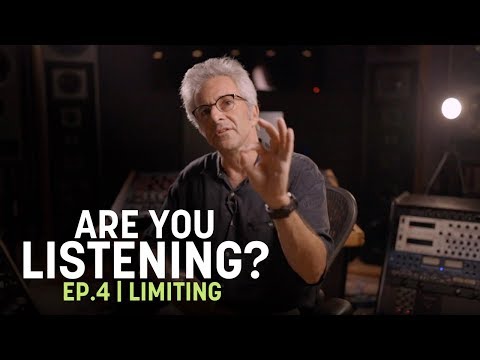
Are You Listening? Ep. 4 | Limiting in Mastering (Part 1)

Watch with subtitles, summary & AI chat
Add the free Subkun extension — works directly on YouTube.
  • Watch
  • Subtitles
  • Summary
  • Ask AI
Try free →

Aspiring mastering engineers and music producers wanting to refine their use of limiters.

TL;DR

Mastering engineer Jonathan Wyner explains how to use a limiter as a safety tool to set target levels without distortion. He covers peak vs. average level, level-matched A/B comparison, and how limiters affect sound quality. Practical tips include setting the limiter first and anticipating streaming service loudness normalization.

Key Takeaways

In This Video

  1. 00:00Introduction to Limiters

    Jonathan Wyner introduces limiters as essential mastering tools.

  2. 00:19History and Function of Limiters

    Limiters were created to prevent distortion in radio broadcasts.

  3. 01:07Setting Target Levels in Mastering

    Limiters help specify target levels like -14 dBFS loudness normalized.

  4. 02:58Two Modes of Using a Limiter

    Fixed threshold with gain increase vs. adjustable threshold with makeup gain.

  5. 04:15Level Matched A/B Comparing

    Level matching is crucial for hearing true limiter effects.

  6. 06:01Peak vs. Average Level Understanding

    Understanding peak and average level is key for effective limiting.

  7. 08:51Limiter's Impact on Sound Quality

    Limiters can cause low-frequency loss and high-frequency distortion.

Questions & Answers

What is a limiter used for in mastering?
A limiter sets a maximum level to prevent distortion, acting as a safety ceiling. It's essential for specifying target loudness.
How do you set up a limiter in mastering?
First, set the limiter to your target level, like -14 LUFS. Then adjust gain or threshold to reach that level while monitoring for too much limiting.
What are the two modes of using a limiter?
One mode fixes threshold and increases input gain; the other adjusts threshold with makeup gain. Both achieve the same effect but work differently.
Why is level-matched A/B comparing important?
It eliminates playback level as a variable, letting you hear true differences between processed and unprocessed audio, crucial for evaluating limiting.
How does a limiter affect sound quality?
It can reduce low frequencies and add high-frequency distortion, often unpleasantly. The bass drives the limiter most due to its high amplitude.
What is the difference between peak and average level?
Peak level is the maximum instant amplitude; average level is the overall loudness. Limiters primarily interact with peaks, not average levels.

Key Terms

Download or copy the punctuated YouTube transcript (Markdown)

Full Transcript

Loading transcript…
Source

YouTube video. Original: https://www.youtube.com/watch?v=Ze-ZrAzu8uA
Transcript captured and processed by youtube-transcript.ai on 2026-07-21.